Daily Shaarli
July 9, 2026

Ingredients
- 1 pkg/Tbsp. Red Star Platinum Yeast
- 1 ¼ Cups warm water
- 2 ½-2 ¾ Cups unbleached, all-purpose flour
- 1 Cup yellow cornmeal
- 3 Tbsp buttermilk powder (original recipe called for ¼ Cup nonfat dry milk powder)
- 3 Tbsp. butter, softened
- 2 Tbsp. sugar
- 1 ½ tsp. salt
Instructions
- Place warm water and yeast in EZ DOH bucket and stir to dissolve yeast.
- Let rest 1 minute.
- Add one cup of flour, then additional dough ingredients.
- EZ DOH-it for 2-3 minutes, or until dough is smooth and soft and all ingredients are incorporated, adding enough flour so that the dough is not sticky.
- Remove dough from bucket, spray bucket with cooking spray, “smooth” dough and replace in bucket.
- Cover and let rise until doubled.
- Remove dough from bucket.
- Roll out into a rectangle, then roll up (jelly-roll fashion) and pinch seam shut.
- Place in a greased loaf pan (I LOVE my hearth loaf pan, which measures 12”x5 ½”x 2 ¼”, for this loaf……if you don’t have a similar pan, it can be baked in a 9x5” loaf pan with a longer baking time, or just shape it into a loaf measuring the size above and bake it on a greased baking sheet).
- Let rise until doubled.
- Bake at 375 for 30-40 minutes.
- Remove from pan and cool on wire rack.
- Brush the top of the loaf with butter.
Ingredients
For the Sponge
- 1 cup milk
- 1/3 cup all-purpose flour
- 2 teaspoons sugar
- 1/2 cup lukewarm water
- 3 (1/4-ounce) packages active dry yeast
For the Dough
- 10 large egg yolks, room temperature
- 2 large eggs, room temperature
- 1 teaspoon salt
- 1 cup sugar
- 8 ounces (1 cup) unsalted butter, melted
- 2 teaspoons pure vanilla extract
- 1 tablespoon lemon zest, grated
- 6 cups all-purpose flour
- 1 cup raisins, light or dark, optional
- 1 large egg, room temperature
- 2 tablespoons milk, or water, room temperature
Instructions
Sponge
- Scald the milk and cool it to 110 F.
- Place 1/3 cup flour in a medium bowl and pour the cooled scalded milk over, beating until smooth. Set aside.
- In a measuring cup or small bowl, dissolve 2 teaspoons sugar in lukewarm water and stir in the yeast.
- Transfer the yeast mixture to the milk-flour paste, mixing well.
- Cover with plastic wrap and let rise until light and bubbly.
Dough
- In a large bowl or stand mixer, beat the egg yolks, whole eggs, and salt.
- Add 1 cup sugar and continue beating until light.
- Beat in the butter, vanilla, and lemon zest.
- Add the sponge to this mixture and mix well.
- Add 6 cups flour and knead 7 minutes by machine or 10 minutes by hand.
- Knead in the optional raisins.
- Cover with greased plastic wrap and let rise until doubled.
- Punch down dough, knead a few times, and let it rise again.
- Grease 3 babka cylinders or food-grade coffee tins and fill each pan 1/3 full.
- Cover with greased plastic wrap and let rise until tripled.
- Brush tops with 1 large egg beaten with 2 tablespoons of milk or water.
- Heat oven to 375 F.
- Bake babkas 10 minutes.
- Then lower temperature to 325 F and bake 30 minutes.
- Then lower temperature to 275 F and bake 15 to 20 minutes longer. Cover tops with aluminum foil, if they are browning too quickly.
- Remove from the oven and let stand in the pan for 10 minutes.
- Turn loaves out of the pan, running a knife around them, if necessary, and cool completely on a wire rack.
- If desired, the cooled loaves can be iced with a simple confectioners' sugar glaze, letting it drip down the sides for a decorative effect.
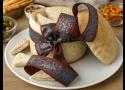
Ingrédients
Pâte
- 750 g de farine boulangère pour pain
- 485 g d'eau
- 30 g de levure de boulanger fraîche
- 15 g de sel fin
Garniture
- 200 g de fromage de brebis
- 2 tranches de jambon blanc
- 2 ou 4 tranches de jambon de Bayonne
- 200 g de beurre ramolli
- 200 g de beurre de roquefort
Instructions
- Pour réaliser cette recette de pain surprise, commencer par préparer tous les ingrédients.
- Verser le sel fin dans la farine. Mélanger et mettre en fontaine.
- Ajouter la levure de boulanger émiettée...
- ...et l'eau tiède.
- Mélanger au batteur (avec l'accessoire crochet) pendant 3 minutes à petite vitesse...
- ...puis poursuivre ce pétrissage pendant 8 minutes à vitesse moyenne. Stopper le pétrissage à ce stade.
- Retirer le crochet, former une boule de pâte...
- ...et couvrir d'un linge propre. Laisser pousser la pâte 20 minutes dans un endroit tiède, comme une chambre de pousse.
- Retirer le torchon...
- ...et rompre la pâte avec la paume de la main.
- Transvaser cette pâte dans un cercle à pain surprise légèrement graissé à l'aide d'un aérosol à graisse. Ce cercle sera également posé sur une plaque à pâtisserie à revêtement anti-adhérent.
- Couvrir d'un torchon propre et laisser lever à nouveau pendant 1h30 à 2h. Lorsque la pâte arrive à quelques centimètres du bord du cercle, retirer le torchon...
- ...et laisser pousser encore quelques minutes jusqu'à ce que la pâte dépasse du cercle et soit bombée sur le dessus.
- Enfourner dans un four ventilé (ou chaleur tournante), préchauffé à 200°C, et laisser dorer entre 30 et 40 minutes selon la grosseur du pain.
- Au terme de la cuisson, retirer le pain du four...
- ...et retirer le cercle en inox. Laisser refroidir.
- Avec un couteau à pain...
- ...découper le chapeau du pain délicatement.
- Remettre le pain droit et enfoncer la pointe d'un couteau filet de sole entre la mie et la croûte de façon verticale. Attention à ne pas transpercer le fond.
- Par un mouvement de haut en bas, découper la mie sur tout le pourtour du pain.
- Veiller à couper la mie jusqu'au fond, en le faisant le plus régulièrement et le plus droit possible, et surtout sans transpercer la croûte du fond.
- Retirer le couteau et le planter horizontalement à 1 cm de hauteur de la croûte du fond. Il est nécessaire de faire une entaille de 3 à 4 cm pour être à l'aise.
- Lorsque le couteau est enfoncé, le faire pivoter du côté tranchant, afin de couper le fond du pain surprise. Veiller à épouser le contour du pain, sans pour autant transpercer la croûte.
- Retirer le couteau, faire pivoter la lame et la réintroduire délicatement dans le même trou et renouveler la découpe du fond, toujours sans transpercer la croûte.
- Retirer le couteau et introduire délicatement la main à la verticale entre la mie et la croûte. Avec le bout des doigts, décoller totalement le bloc de mie de sa croûte. Faire de même sur tout le pourtour. Attention à ne pas l'abîmer.
- Retirer le bloc de mie et réserver la croûte et le chapeau.
- Découper au couteau à pain le bloc de mie en 8 tranches régulières, d'épaisseur égale. Attention à ne pas les casser.
- Beurrer la surface des tranches de mie.
- Disposer le jambon de Bayonne...
- ...et recouvrir d'une seconde tranche de mie. Presser pour bien faire adhérer et découper au ciseaux le jambon qui déborde sur le pourtour.
- Faire de même avec le beurre de roquefort...
- ...que vous aurez préparé préalablement et qui aura la consistance d'une pommade.
- Continuer avec du jambon blanc et enfin avec le fromage de brebis. Vous pouvez laisser marcher votre imagination pour trouver d'autres idées de garniture.
- Découper chaque galette de pain de mie garni...
- ...en 8 avec un gros couteau éminceur.
- Disposer les mini-sandwichs dans le pain de mie...
- ...afin de reconstituer le pain.
- Il est possible de faire un étage de chaque (un étage de jambon, un étage de roquefort, etc...) ou bien de mélanger toutes les variétés.
- Refermer le pain surprise avec son couvercle. Juste avant de le servir aux invités, parfaire sa présentation en l'entourant d'un ruban à charlotte. Bon appétit !
Ingredients
- 2 1/4 cups warm water (not more than 115F / 46C)
- 2 teaspoons sugar
- 2 1/4 teaspoons yeast
- 2 tablespoons shortening (only if you add onion to the dough)
- 1/3 cup sweet onion, finely chopped (I did not use onion in the dough)
- freshly ground black pepper, to taste
- 3 cups (approx 400 grams) bread flour
- 2 tablespoons canola oil (I used peanut oil)
- 1 cup sweet onion, finely chopped (I used white onions)
- 2 teaspoons poppy seeds
- 1 tablespoon salt
- 3 cups (approx 400 grams) bread flour
Instructions
- For the sponge: In a large glass bowl, whisk together the water, sugar and yeast and allow to stand about 5 minutes or until foamy. If using onions in dough: In a small saute pan over low heat, sweat 1/3 cup onion in shortening until it’s soft and translucent.
- With a wooden spoon, stir the flour and onion mixture into the yeast mixture. Stir for about 3 minutes then cover tightly with cling film and let stand about 90 minutes or until doubled and bubbly.
- For onion topping: Sweat remaining onion in canola oil with poppy seeds over low heat until translucent, set aside to cool.
- For the bialys: Preheat the oven to 500 F. Place an oven proof pan or baking tray in the bottom of the oven and your baking stone or heavy baking tray in the center.
- When the sponge is ready, add salt and 2 cups (approx 260 grams) bread flour and begin to knead the soft dough right in the bowl. Add as much flour as is needed to obtain a workable dough and knead until it’s soft and pliable, about ten minutes total.
- Cover the bowl tightly with cling film and allow to rise until doubled in bulk, about 90 minutes.
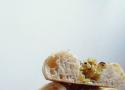
Divide the dough into 12 portions and shape each into a round about half an inch thick. Create a depression in the center and prick well with a fork. - Divide the onion mixture evenly between the breads and prick the centers again before baking.
Put ice cubes or cold water into the skillet or baking tray to create steam. Transfer the breads onto your baking stone or baking tray with a bit of cornmeal to prevent sticking. (I used a cookie sheet to help transfer the bialys onto a baking stone) - Bake ten minutes at 500 F, reduce temperature to 450 and bake a further 5 minutes or until golden brown. Cool on a wire rack