
Especially aluminium tent pegs are a bit tricky. Most metals will become harder as they are 'worked' (as in getting bent) and the initial bend when you hit the stone will have the effect that the bend itself is harder than the straight metal around it. So if you now try to bend them back in shape you will notice the peg bending left and right of the original bend but that one just stays where it is. If you finally manage to straighten it out, the harder and therefore more brittle metal may snap. This effect is called work hardening and is especially pronounced in aluminium. For this metal it is also especially tricky to reverse, i.e. to get it soft again. The process for this softening is called annealing and for aluminium you will have to heat the metal to a temperature that is uncomfortably close to its melting point. A bit of a challenge when camping or without a metal workshop at home. But I think not impossible.
Below I'll explain how to anneal aluminium. If you have a steel peg (much easier to work than aluminium and less likely to break) or if you can't be bothered annealing the aluminium peg you can skip to the two ways to straighten the metal. For unannealed aluminium I would not recommend method 2 though, as it will most likely break.
Annealing of aluminium: In short, the purpose of the annealing process is to remove stress inside the metal, which causes it to become less workable. Aluminium needs to be heated to a temperature close to it's melting point (but obviously not above) and then doused in water, i.e. cooled down quickly.
You need plain household soap without additives like fragrances, skin conditioners etc. - this will be used as a makeshift temperature indicator so you know you've reached the right temperature without accidentally melting it. Furthermore you want a heat source like a blow lamp (I don't know if a gas camping cooker will work but it may be worth a try), a vessel with water to douse the heated peg and cool it rapidly down and a pair of pliers or disposable cotton cloth or whatever seems suitable to hold the hot peg without burning your fingers (maybe you could try and place the peg on a camping cooker where it is immersed in the flames instead).
Firstly cover the peg with soap directly from the bar (without water). Now heat the peg up until the soap on it turns black. Try to spread the heat evenly over the affected area. Watch very carefully for the soap to change colour as it is now almost hot enough to melt. Once there, quickly douse the peg in water.
If you were to try this on a camping stove you may want to apply some insulation to the straight parts of the peg so the heat you apply to the bent bit doesn't dissipate away too quickly (or you may never reach the required temperature). An old rag of tightly woven wool, or better even leather, should work well as these materials don't combust that easily - it will stink right enough and the rag will be ruined. Improvise with appropriate care.
This process can be repeated if you don't feel it worked well the first time. You will have to clean the peg before that - grinding the grime off with sand should work fine or ideally some emery paper if you have it. If you don't clean it you won't see the soap turning black.
You can find more hand-on information about annealing of common metals here.
Careful: Don't burn yourself. The metal will be very hot. Don't touch it with your fingers and take care it can not accidentally fall on you.
Straightening the metal (1): Now you should be able to bend the peg back. The perfect tools for this job would be a sturdy pair of mole grips to hold the peg (but if you are careful your hand will do), a hammer and anvil. I know, if you had a blacksmith workshop at home you would not be asking this question. However for a thin piece of metal like aluminium you should be able to use the tools of our ancestors from the days before metal smelting was discovered and use stones. You'll want to pick a hammerstone that is comfortable in your hand. You want to start with an anvil stone with a bend only slightly less than the bend in your peg. Place the peg on the anvil stone so the inside of the bend points to the anvil. There should be some space between the peg and the anvil stone right in the middle of the bend but the two points where peg and anvil are touching should not be too far away from each other, maybe three quarters of an inch (for really tight bends) to two inches (for wider bends). Hit with the hammerstone the middle of the bend. Continue this while turning / exchanging the anvil stone to suit the bend until you end up with one that is almost flat. As a rule your next hit with the hammerstone should always go to the back of the middle of the bit that is bent the most.
This may sound a bit complicated when described in writing but once you get the hang of this, the details will make sense naturally and it is surprisingly simple to do. Your peg won't look like new obviously, but you will be surprised how straight you can get it with this method.
Careful: If you hit the peg with the hammerstone it will jump in your hand unless it was perfectly aligned and all the energy from the hit is dissipated by bending the metal back. If you happen to get this always right from the start consider a career as a blacksmith - you are a natural. If you don't it will hurt. If you have it, use a suitable pair of pliers. A molegrip would be ideal. You could also use a bit of fabric (or better, leather) wrapped around the peg to dissipate the shock of the impact. Don't try to hold the peg to tight. Allow it to jump. The hammer and anvil stones are supposed to take all the force from the hit, not your hand.
Straightening the metal (2): If you can find a hole in a metal fence or similar you could insert the peg to just before the bend. Then you could insert the other side of it in a pipe and use the leverage to bend the peg back. Sometimes it is quite hard to prevent the peg from spinning away and to keep it straight that way. Instead of a pipe you could use a spanner with a ring, or any other metal tool item with a hole where the other side of the peg can be inserted. To prevent the peg from spinning, put the tool on in a way that you pull it rather than push. This method is quicker to do if you can find the tools but the result is somewhat cruder. It is also more stressful for the metal - so it is more likely to break your peg.

What Is a Yo Yo Quilt?
Yo-yo quilts are made from round pieces of fabric with long stitches along their turned-under outer edges. Stitches are pulled to gather the circles into rosettes.
Individual yo-yos are typically hand sewn side by side into rows when they are used to make a quilt, but they also work nicely for 3-dimensional appliqué embellishments.
Yo-yo quilts were popular in the 1930s and 1940s, and there are many lovely examples sewn with fabrics from those eras. Some were structured, with the rosettes arranged to form a pattern, but many of the examples are scrap quilts.
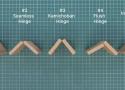
One doesn’t generally associate cardboard with structural components like hinges, but [Itoshige Studio] assures us that you can absolutely create hinges out of this ubiquitous material
. In total the video covers five different designs, ranging from the simple and straightforward to an interlocking tab design that approximates a typical steel hinge with paper rod to keep both sides of the hinge together.
The most simplistic hinge is unsurprisingly just a strip of craft paper, which is also demonstrated as the hinge for a wooden box in lieu of the typical metal hinge. This same principle is then demonstrated for a fancy cardboard box.
From here the designs get increasingly more involved. First a seamless hinge variation, and then a kamichoban hinge design that’s inspired by traditional Japanese room dividers and furniture, using panels that are interconnected with overlapping sections to create a fascinatingly flexible hinge that can fully fold either way.
The flush hinge design is somewhat like the craft paper hinge, but significantly fancier and probably sturdier, while also looking pretty good on something like a cabinet. Finally the interlocking tab hinge is effectively a cardboard version of the hinge design that’s found on every room’s door, with a similar level of flexibility. This is obviously the trickiest one to assemble and get right, but it has its own charm.
Considering that all of these examples use regular corrugated cardboard that we get shipped to our homes by the truckload, the cost to try these examples is your time plus some basic tools and glue. The author also sells a book that contains templates – in addition to digital versions – for these hinges and other designs, if you’d like to enjoy the 100% paper experience.
- How to Make and Sew Bias Tape - Melly Sews
- How To Make Bias Tape and Piping | Closet Core Patterns
- How to Make Bias Binding (with Video Tutorial!) - Suzy Quilts
- How to Make Bias Binding Tape - Two Ways - Bethany Lynne Makes
- How To Bind A Round Quilt With Bias Binding | Quilts By Jen
- How to make Bias Binding for Quilts Tutorial
- How to Sew on a Bias Tape Binding and Join the Ends – Bobbin In Quilts
- Quilt 101, Lesson 8- Binding — Joz Makes Quilts
How to Do Bias Binding Math
So how do you know how many yards of bias binding you’ll need for a quilt?
Get your calculators ready, because here is the simple equation!
Add up the length of all four sides of your quilt.
Add 18 to the total (this is to give you enough for mitered corners and joining up your ends).
Divide that total by 36 (because 36 inches in a yard) and then round up to the next whole number.
For example, if you have a throw quilt that is 50x50:
50+50+50+50 = 200
200 + 18 = 218
218 ÷ 36 = 6.1
So, rounding up, you would need 7 yards of binding to complete the quilt!



The Gold Collection → pour acheter les CPs
Easy Folding Guide



- Sewing Tutorials How to Add a Lining to Any Sewing Pattern (Even When the Pattern Doesn't Include One) If you're working on a sleeveless garment without button closures, the burrito method creates the cleanest possible finish by essentially rolling the fabric out of the way as you work September 26, 2025
- Sewing Tutorials How to do the Burrito Method on a Lined Yoke The burrito method is a little bit of sewing magic when sewing certain kinds of linings. What’s the burrito method? January 16, 2023
- Sewing Tutorials How to do the Burrito Method on a Sleeveless Garment In part 2 of the burrito method series, we’ll show you how to use this technique on a sleeveless garment. January 23, 2023
- Sewing Tutorials How to Sew a Lining Using the Burrito Method The burrito method is easy when you follow these steps. ... The " burrito method" may seem complicated, but once you learn how to do it, it'll feel like magic! November 20, 2020
- Sewing Tutorials Seamwork's Best Sewing Techniques How to do the Burrito Method on a Lined Yoke: Use this sewing magic trick to get a clean finish on lined yokes. November 14, 2024