- Au Petit Poucet → charcuteries
- Érablière du Coeur Sucré → produits de l'érable biologiques
- Gourmet Sauvage → produits sauvages
- La Manufacture → gins
- La Veillée → bières de microbrasserie
- Miel de la Garde → miels biologiques
- Pascal Le Boulanger → boulangerie
- Tabarnasco → sauces piquantes
- Tribe Kombucha → kombucha

Ingredients
- 1 cup butter
- 1 cup brown sugar
- 1 cup white sugar
- 2 eggs
- 1 tsp vanilla
- ¾ tsp salt
- 1 tsp baking soda
- 2 cups flour
- 1 cup chocolate chips
Instructions
- Melt butter in a cast iron.
- Turn off the heat
- Add remaining ingredients and mix.
- Bake on 325°F for 25 minutes.
Testé. Ce n'est pas concluant.
- 4 Non Blondes - What's Up (Official Music Video) - YouTube
- Amyl and The Sniffers - "U Should Not Be Doing That" (Official Music Video) - YouTube
- Amyl and The Sniffers - Guided By Angels - YouTube
- Bonnie Tyler - Total Eclipse of the Heart (Turn Around) (Official Video) - YouTube
- Comfort To Me | Amyl and the Sniffers
- Da Hool - meet her at the Loveparade - Official Video (HQ) - YouTube
- Disturbed - The Sound Of Silence (Official Music Video) [4K UPGRADE] - YouTube
- Europe - The Final Countdown (Official Video) - YouTube
- New Order - Blue Monday (Live at Alexandra Palace) - YouTube
- Ram Jam - Black Betty (Official Video) - YouTube
- RUN DMC, Jason Nevins - It's Like That (Official HD Video) - YouTube
- Sash! - Encore Une Fois (Official Video) - YouTube
- The Cloverhearts - Heartbreaker (Official Video) - YouTube
- The Prodigy - Firestarter (Official Video) - YouTube
- The Rolling Stones - Paint It, Black (Official Lyric Video) - YouTube
- Virile - YouTube
Ingrédients
- 1 bouteille de crémant de Loire
- 1 citron
- 15 cL de cointreau
- 12 cL de sirop de sucre de canne
Instructions
- Mettre au frais la bouteille de crémant de Loire.
- Presser le citron.
- Une fois que la bouteille est bien fraîche, verser le contenu dans un saladier et y ajouter le Cointreau, le sirop de sucre de canne et le citron pressé.
- Servir bien frais.
Des flûtes à construire soi-même.
-
Are you planning to climb Mont Blanc and wondering what you should wear? (Part 1)
Mont Blanc is at 4806m, or almost 5000m, so you’ll need warm, appropriate clothing that’s not too heavy.
✅ One pair of crampon boots that are warm enough and, if possible, not too heavy
✅ One pair of socks that are warm but not too thick, that you’ve tested beforehand and that won’t give you blisters
For the body, we prefer the system of different layers.
✅ A long-sleeved merino or synthetic (avoid cotton) first layer
✅ Some Merino or synthetic tights
✅ fleece, with or without a hood (a hood will provide extra warmth in windy conditions)
✅ Down jacket
✅ Down vest (optional)
✅ Shell jacket for protection in rain or snow and against the wind
✅ Shell or softshell pants, depending on the temperature and weather forecast
✅ One pair of warm gloves
✅ One pair of thinner gloves
✅ One pair of warm, compact mittens as a back-up (optional)
✅ One pair of glasses with category 4 lenses
✅ One category 4 mask (optional, depending on the weather)
✅ Cap
✅ Buff
✅ Hat that goes under the helmet
Don’t take anything superfluous or too heavy. The lighter you are, the more fun you’ll have! -
You’re planning to climb Mont Blanc and you’re wondering what non-technical equipment you need in addition to clothing for the ascent? (Part 2).
✅ When it comes to your hydration system, a lightweight thermos flask and/or water bottle is preferable to a camelback. A camelback’s tube will freeze above 4000m in the cold and wind and you won’t be able to keep hydrated.
✅ Snacks. There are plenty of nice snacks to take with you, as well as a small savoury snack. You’ll need to last between 7 and 10 hours on foot
✅ A small tube of sun cream and sun protection lip stick
✅ A first-aid kit with a small toothbrush, a small tube of toothpaste and a sample of cream. Don’t take your complete toiletries kit with a towel, as there isn’t always water in the refuge
✅ One Lightweight change of dry underwear for the upper body when you get sweaty to the hut
✅ A spare pair of dry socks for the hut
✅ A small extra-light fabric bag (avoid the plastic bag, which makes a lot of noise and wakes everyone up when you touch it) to fit all the small items you won’t need for the ascent day
✅ Headlamp (fully charged)
✅ Liner bag for the hut
✅ One back pack of at least 30 liters, light when empty, functional and equipped for the high mountains, with ice axe holders
Remember to pack light - you’ll get a lot more out of your ascent of Mont Blanc -
You’re wondering what technical gear to take for climbing Mont Blanc?
✅ Crampons-compatible boots that are warm enough for the temperatures up there. Sometimes it can be quite warm to climb Mon Blanc and some other times It can be very cold. So, choose your boots accordingly. Don’t hesitate to rent a pair suitable for the temperatures you’ll face at 4,800 meters. Remember to get boots slightly larger than your usual size. Your feet shouldn’t be compressed, or blood won’t circulate properly.
✅ Crampons. For Mont Blanc, we’ll use classic mountaineering crampons such as Vasak model. They have a semi-automatic attachment system that’s efficient, practical, and quick to put on.
✅ Light weight pouch to pack your crampons. It’ll protect everything else in your bag from the crampon points.
✅ Harness. Choose a lightweight, simple harness that you can put on with crampons, like this one with opening leg loop buckles.
✅ Personal Anchor
✅ Screw carabiner, preferably directional
✅ Ice screw with a small, lightweight carabiner. No need for another screw carabiner;
✅ Small carabiner to hang gloves or an ice axe when you need both hands free.
✅ A classic, mountaineering ice axe. Choose one that’s long enough for your height, with a good pick at the bottom. A short ice axe won’t provide proper support.
✅ Helmet : to protect your head from possible falling rocks and/or from a crevasse fall.
✅ Lightweight, foldable poles that fit in your bag without sticking out.
✅ 30-liter backpack with ice axe holders, comfortable back, simple and light
Really consider the weight. Find light, safe gear that suits your needs. With the right gear, you’ll be safer and enjoy your Mont Blanc climb more. -
How do you pack a backpack for mountaineering?
The principle is always the same: put the heaviest items at the bottom of the bag and against your back.
For example, I’m heading to Refuge Tête Rousse before climbing Mont Blanc. I’ll put my crampons in a pocket to protect my gear and place them at the bottom.
I also consider what I’ll need first and what I won’t. To hike up to a mountain hut, you rarely need very warm gloves. So we’ll put warm gloves at the back, against our spine, to avoid sharp objects there.
Then we’ll fill in the small spaces.
I do the same with my down jackets, placing them against my back for comfort.
I always put my thermos on the left side of my backpack. That way, I know exactly where to find it every time. I’ll do the same with my water bottle, placing it on the opposite side.
Other items we won’t use right away: spare clothes, headlamp, first-aid kit… All these can go near the bottom of your backpack since you won’t need them immediately.
Small items and snacks go in a pocket for easy access.
The sleeping bag liner also goes in front; we won’t use it soon.
Lastly, I’ll put technical gear on top with light gloves in case it’s cold.
To attach the ice axe, thread the elastic anchor through its head and secure it. There’s another elastic here; pull it and adjust the ice axe as needed.
You can either put your helmet on top of the backpack - it’s neat and tidy when you close the bag. Some prefer to attach the helmet on the outside. The key is to secure the helmet so it doesn’t bounce around. Fasten it properly to prevent swinging with each step.
Now you’re all set and organized.
With a compact pack and heavy items low against your back, you’re ready for hours of hiking.
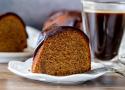
Ingredients
Coffee Bundt Cake
- 3 cups all-purpose flour (375 grams)
- 1 teaspoon baking powder
- ½ teaspoon baking soda
- ¼ teaspoon salt
- ½ cup unsalted butter (112 grams) softened
- ½ cup vegetable oil (120 ml) or canola
- 2 cup light brown sugar* (400 grams) packed
- 4 large eggs room temperature
- 1 cup sour cream (240 ml) room temperature
- 3 tablespoons instant coffee powder feel free to use 2 tablespoons for a less intense flavor
- 2 tablespoons hot water (30 ml)
Chocolate Ganache
- 4 ounces dark chocolate (112 grams) around 50%, or feel free to use semi-sweet`
- ½ cup heavy cream (120 ml)
Instructions
Coffee Bundt Cake
- Preheat the oven to 350F (180C or 160C fan forced).
- Whisk together the flour, baking powder, baking soda and salt.
- In a very large mixing bowl, beat together the butter, brown sugar and oil until creamy (seeing sugar granules is fine).
- Beat in the vanilla extract and eggs 1 at a time. Stop mixing when you no longer see pieces of egg in the batter.
- Turn off the mixer and scrape down the sides and bottom of the bowl. Add in about 1/2 of the flour mixture and beat on a low speed until just combined.
- Add the coffee grounds to the hot water int a small cup or bowl and stir. Add the coffee and sour cream to the cake batter and mix with the beater on a low speed until combined.
- Turn off the mixer and add in the rest of the flour mixture. With a hand held whisk, whisk until smooth.
- Brush a non-stick bundt pan with pan release/cake goop or grease and lightly dust with flour.
- Pour the batter into the prepared pan.
- Bake in the preheated oven for 45-55 minutes, or until an inserted toothpick comes out clean.
- Let the cake cool in the pan for about 15 minutes, then carefully invert the pan and slide the cake out.
Chocolate Ganache
- Chop the chocolate into very fine pieces and place in a heatproof bowl.
- Heat the cream until almost boiling.
- Pour the hot cream over the chopped chocolate. Let sit for 3-5 minutes, then whisk until smooth.
- If there are still some lumps of chocolate, microwave for 30-second intervals at medium heat (not high heat, which is often the default) and whisk between each interval until smooth.
Assembly
- If the bottom of the cake is very domed (what was the top while the cake was baking), gently saw off the rounded top using a serrated knife.
- Place the cake on a plate or cake stand that you plan to serve it on.
- Pour/drizzle the chocolate ganache over top, letting it drip over the sides.

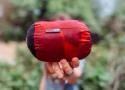
Private Artifacts Never To Share ou Bug Out Bag :)
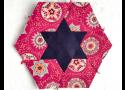


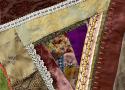
- Sewing Tutorials How to Add a Lining to Any Sewing Pattern (Even When the Pattern Doesn't Include One) If you're working on a sleeveless garment without button closures, the burrito method creates the cleanest possible finish by essentially rolling the fabric out of the way as you work September 26, 2025
- Sewing Tutorials How to do the Burrito Method on a Lined Yoke The burrito method is a little bit of sewing magic when sewing certain kinds of linings. What’s the burrito method? January 16, 2023
- Sewing Tutorials How to do the Burrito Method on a Sleeveless Garment In part 2 of the burrito method series, we’ll show you how to use this technique on a sleeveless garment. January 23, 2023
- Sewing Tutorials How to Sew a Lining Using the Burrito Method The burrito method is easy when you follow these steps. ... The " burrito method" may seem complicated, but once you learn how to do it, it'll feel like magic! November 20, 2020
- Sewing Tutorials Seamwork's Best Sewing Techniques How to do the Burrito Method on a Lined Yoke: Use this sewing magic trick to get a clean finish on lined yokes. November 14, 2024
Kitchen work is all about proportions: sometimes the recipe is for four servings but you need six; maybe the recipe calls for 80 g of butter but you only have 57 g, so you have to adjust the other ingredients to match.
We could use an electronic calculator to figure out the rescaled amounts, but a slide rule makes it so much easier. The picture above was taken while following a recipe that called for 2 tsp of baking powder, and I wanted to make as large a batch as I could given the remaining 3.3 tsp of baking powder I had – a proportion of 2:3.3. You can see the slide rule is set to a proportion of 2:3.3 because – if you open the image in a new tab to make it larger – the number 2 on the C scale (on the bottom of the sliding middle part) is above 3.3 on the D scale just below.
But wait, the number 1 on the C scale is also just above 1.65 on the D scale. And 14 (or, if you will, 1.4, since with slide rules we ignore decimal points) on the C scale is above 23.1 on the D scale. Indeed. It’s set to those proportions too, because they are the same proportion. This is what makes the slide rule so powerful.
Once the slide rule is set to the constraining proportion, in this case 2:3.3, we can instantly read off all other amounts from it with no additional manipulation. If the recipe calls for three cups of flour, we’ll find 3 on the C scale and look what’s below it on the D scale: seems like we need 4.95 cups of flour. The recipe says 25 g of butter: we’ll take what’s under 25 on the C scale, i.e. 41.25 g. Having set the slide rule once, it then serves as a custom scaling table for the rest of the recipe.
Kitchen work is all about proportions, and nothing beats the slide rule for proportions. The reason I write this article is I just found myself in someone else’s kitchen and they didn’t have a slide rule. Only then did I realise how much I take my kitchen slide rule for granted.
Bakers understand the importance of proportions in cooking; they even write their recipes normalised to the weight of flour, meaning all other ingredients are given in proportion to the amount of flour. This makes it easier to compare recipes, too, because when they are normalised to the weight of a common ingredient, it is easier to see which recipe is sweeter, saltier, umamier, etc.
We can use the slide rule to scale recipes while cooking, but we can also use it when learning to cook something new, by taking a hint from the bakers. We look at multiple recipes and – using the slide rule – write up a table with the relative proportions of each ingredient in each recipe. This lets us see which ingredient amounts must be precise (they vary little between recipes) and which are added mainly to taste (they vary more between recipes.) Here’s an example for regular basil pesto:
| Ingredient | 1 | 2 | 3 | 4 | 5 | 6 |
|---|---|---|---|---|---|---|
| Olive oil (cups) | 0.5 | 0.5 | 0.5 | 0.5 | 0.5 | 0.5 |
| Pine nuts (cups) | 1 | 0.3 | 0.2 | 0.5 | 0.3 | 0.5 |
| Basil (cups) | 4 | 2 | 0.6 | 3 | 2 | 2 |
| Parmesan (cups) | 0.5 | 0.5 | 0.4 | 0.5 | 0.3 | 0.7 |
| Garlic (cloves) | 1 | 3 | 4 | 4.5 | 2 | 2 |
| Lemon (tbsp) | 4 | − | − | 0.5 | 1 | 3 |
Although the coefficient of variation is quite high for all ingredients, it seems that pine nuts, basil leaves, garlic, and lemon juice are all added to taste, whereas the parmesan is important for the structure of the pesto.
Everyone should have a slide rule in their kitchen drawers. I’m honestly surprised it is not standard equipment. Once set up, it’s a mess-free, multitasking-friendly way to achieve instant calculations with almost no work.
J'ai testé. À reproduire !

Ingrédients
- 4 à 5 citrons non traités
- 1 beau morceau de gingembre frais bio (avec la peau)
- 60g de sucre
- 1L d’eau non chlorée
Instructions
- Presser les citrons, les placer dans un bocal avec le gingembre en morceaux, le sucre, puis recouvrir d’eau non chlorée.
- Bien mélanger, fermer le bocal, et laisser fermenter 3 à 5 jours à température ambiante (au-dessus de 20°C si possible).
- Remuer une fois par jour pour faire entrer les levures de l’air, qui favorisent la fermentation. Des petites bulles devraient apparaître : signe que ça prend vie !
- Filtrer la boisson, puis la transvaser dans une bouteille hermétique (type limonade) pour une seconde fermentation de 2 à 4 jours.
- Penser à dégazer quotidiennement pour éviter toute explosion ou geyser à l’ouverture !
- Placer au frais, et déguster bien frais.
Note c'est bon mais c'est très amer. À tester à l'orange pour voir si c'est mieux.