1865 shaares
178 results
tagged
pain
Ingredienti
- 500g farina tipo 0 (forza W350 o almeno 13g di proteine)
- 500g acqua fredda (100% idratazione)
- 3g lievito di birra secco (o 5g fresco)
- 12g sale
- 20g olio extravergine d’oliva
Procedimento
- Sciogli il lievito e il sale nell’acqua, poi aggiungi la farina. Mescola fino a ottenere un impasto grezzo.
- Dopo 20 min, aggiungi l’olio e fai delle pieghe in ciotola fino a renderlo liscio.
- Copri e lascia riposare 30 min, ripeti le pieghe(3 pieghe tot ogni 30 min).
- Trasferisci in frigo per 12–24 ore.
- Riporta a temperatura ambiente, versa in teglia ben oliata e fai lievitare ancora 2 ore.
- Aggiungi i pomodorini, olio, sale grosso e origano. Inforna a 230°C per circa 20–25 min (fino a doratura).
- Lascia intiepidire e… goditi questa nuvola! 🤌

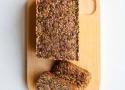
Ingredients
- 1 ½ cups dry steel cut oats
- ½ cup whole flax seeds
- ½ cup pumpkin seeds pepitas
- ½ cup sunflower seeds
- ½ cup quinoa flakes or oat flakes (see notes)
- 3 tablespoons whole psyllium husks
- 1 ½ cups water
- 4 teaspoons apple cider vinegar
- 1 ½ teaspoon salt (optional)
Instructions
- Soak the steel-cut oats: Place the steel-cut oats in a bowl and cover generously with water. Soak for 6 to 7 hours, until the oats are pliable and can be pressed between your fingers but still retain their shape. Do not oversoak. Drain very thoroughly using a fine mesh sieve.
- Combine the dry ingredients: Add the drained steel-cut oats, flaxseeds, sunflower seeds, pumpkin seeds, quinoa flakes, psyllium husk, and salt, is using, to a large bowl. Mix until evenly combined.
- Mix the liquids: In a separate container, stir together the water and apple cider vinegar.
Mix wet with dry: Pour over the oat and seed mixture. Mix thoroughly. Stir very well, making sure the psyllium and liquid are evenly distributed and there are no dry pockets. - Rest: Let the mixture sit for 25 to 30 minutes. This gives the psyllium time to fully hydrate and helps bind the loaf.
- Pack the loaf pan: Transfer the mixture to a nontoxic nonstick or parchment-lined 8 ½ x 4 ½-inch loaf pan. Press the mixture down very firmly and evenly. Compacting the mixture well is important for a loaf that holds together when sliced.
- Bake: Bake on the middle rack at 325°F (163°C) for 90 minutes.
Optional for a firmer crust: Carefully remove the bread from the pan for the final 10 to 15 minutes of baking and place it directly on the oven rack or a baking sheet. - Cool: Let the porridge bread cool completely, preferably on a cooling rack, before slicing. Allow at least 30 minutes so the loaf has time to firm up.

Ingrédients
- 90 ml de lait de votre choix (amandes pour moi) + un peu plus pour la dorure
- 60 g de sucre en poudre
- 30 g de beurre demi-sel coupé en morceaux
- une pincée de sel (optionnel si vous utilisez du beurre salé)
- 3 à 4 g de levure sèche de boulanger (2 à 3 c. à café)
- 2 œufs
- 285 g de farine + un peu plus
- 1 à 2 c. à café de cardamome moulue
- 65 g de fruits secs (raisins blonds, raisins de Corinthe et cranberries pour moi)
- 45 g de cubes de citron confit
Instructions
- Dans une petite casserole, faites tiédir le lait puis hors du feu, ajoutez le sucre, le sel et le beurre coupé en morceaux, remuez jusqu'à ce que le beurre soit fondu puis réservez.
- Dans un grand saladier, versez 60 ml d'eau tiède puis ajoutez la levure sèche de boulanger en pluie et remuez jusqu'à complète dissolution. Ajoutez le mélange lait/beurre/sucre puis les œufs battus et mélangez.
- Ajoutez la moitié de la farine tamisée et la cardamome moulue et mélangez bien. Ajoutez les fruits secs et confits et mélangez. Ajoutez l'autre moitié de la farine tamisée progressivement et mélangez avec une cuillère en bois puis terminez avec vos mains et ajoutez encore de la farine si besoin, jusqu'à ce que vous puissiez former une boule de pâte, couvrez et laissez reposer une dizaine de minutes.
- Sur un plan de travail fariné, pétrissez la pâte à brioche pendant 10 minutes puis transférez la boule de pâte dans une saladier graissé, couvrez d'un torchon propre et laissez pousser environ une bonne heure dans un endroit tiède et à l’abri de l'air comme un four préchauffé à 25-30°c environ, la boule de pâte devra avoir doublé de volume.
- Sortez la boule de pâte et déposez-la sur un plan de travail fariné et dégazez-la (appuyez avec le point de la main).
- Recouvrez une plaque recouverte de papier cuisson et déposez-y la boule de pâte, couvrez d'un torchon et laissez pousser dans une endroit tiède à nouveau entre 1h et 1h30 (ou plus si besoin), jusqu'à ce que la pâte ait doublé de volume à nouveau.
- Préchauffez votre four à 160°c (th. 5-6) puis enfournez pour une première cuisson de 15 min. Au bout de 8 min, sortez le pain brioché et badigeonnez-le d'un mélange lait + sucre. Puis couvrez d'une feuille de papier aluminium et poursuivez la cuisson pendant 15 maximum, surveillez la cuisson, votre pain brioché est prêt lorsqu'il est bien doré et qu'une belle croute s'est formée à l’extérieur (le mien l'était au bout de 10 min). Sortez-le et laissez-le tiédir ou refroidir sur une grille et dégustez immédiatement, nature, grillé ou recouvert de ce qui vous plait accompagnée de votre boisson préférée.
Ingrédients
- 15cl de lait
- 10g de levure de boulanger
- 3 cuillères à soupe d'huile de pépin de raisin
- 1 cuillère à café de sucre en poudre
- 1 cuillère à café de sel
- 500g de farine
Instructions
- Dans une casserole, faites tiédir la lait à feu doux puis incorporez la levure.
- Délayez puis laisser gonfler pendant 5 minutes.
- Mélangez ensuite cette préparation avec 15cl d'eau tiède, 2 cuillères à soupe d'huile de pépin de raisin, le sucre et le sel.
- Dans un saladier, versez la farine et creusez un puit.
- Versez la préparation liquide en une seule fois et malaxer jusqu'à ce que la pâte ne soit plus collante.
- Pétrissez encore pendant 2 minutes en aérant la pâte.
- Formez une boule, couvrez-la d'un torchon et laissez reposer pendant 3 heures à l'abri des courants d'air.
- À l'issue de ces 3 heures, pétrissez à nouveau la pâte et divisez-la en 4 parts égales.
- Aplatissez chaque part puis abaissez-les pour former 4 disques.
- Laissez reposer pendant 1 heure dans un endroit tiède.
- Avant la cuisson, badigeonnez les faluches d'huile de pépins de raisin et saupoudrez de farine.
- Faites cuire à 180°C (th6) pendant 15 minutes, les faluches doivent rester pâles et leur croûte très tendre.
- Laissez refroidir les faluches sur l'envers.
Ingredients
Tangzhong
- 4 Tbsp (60g) whole milk or unflavored almond milk
- 2 Tbsp (27g) water
- 2 Tbsp (20g) bread flour
Dough
- ½ cup (120g) whole milk or unflavored almond milk
- 1 Tbsp (9g) instant yeast
- 2.5 cups (320g) bread flour, plus more for bench flour
- 2.5 Tbsp (35g) granulated sugar
- 1 tsp (7g) fine sea salt
- 1 large egg, room temperature
- 1 large egg yolk, room temperature
- 3 Tbsp (42g) unsalted butter, softened
- Cooking spray, for greasing
Egg Wash
- 1 large egg
- Splash of whole milk
- Melted butter or browned butter
Instructions
Tangzhong
- Whisk all the ingredients together in a small saucepan.
- Once combined, place over medium heat, and constantly whisk until the mixture thickens into a paste.
- Remove to a small bowl and set aside.
Dough
- Warm the milk to 95°F (35°C).
- Whisk in the instant yeast until dissolved.
- Store in a warm area and let sit for 8 minutes.
- In a stand mixer bowl whisk together the dry ingredients.
- Add the dough hook and turn the mixer on low.
- Slowly stream in the milk and yeast mixture and mix for a few seconds to combine.
- Add the tangzhong paste, egg and egg yolk.
- Turn the mixer speed up to medium-low and continue to mix until evenly combined, turning the machine off and scraping down the sides of the bowl intermittently throughout mixing.
- Gradually add the butter in pieces, mixing the butter into the dough completely before adding more.
- Once the butter is incorporated, continue to knead the dough at medium-low speed for 5-8 minutes, or until the dough is smooth.
- Lightly grease a medium bowl and set aside.
- Remove the dough from the stand mixer and gently fold all the sides towards the center to help form a ball.
- Place the dough seam side down on a clean work surface and roll it around on the board to create a tight, smooth ball.
- Place the dough in the greased bowl, cover with a damp towel and place in a warm area to proof and double in size, about 1 - 1.5 hours.
- After the dough has risen, punch the dough down and place on a lightly floured work surface.
- Using a bench scraper, divide dough into 6 even pieces around 95–105 grams each.
- To shape the individual buns, place one dough piece in the center of your board.
- Gently stretch and fold the edges of the dough towards the center.
- Flip the dough so it is seam side down.
- Using your fingers pull the dough toward you, making sure the dough keeps contact with the board the entire time, to start to create tension and form a tight dough ball.
- Rotate the dough 90 degrees and repeat this process two more times or until you have done this for the entire perimeter of the bun and have a smooth, tight dough ball.
- Line a rimmed sheet tray with parchment paper and lightly grease the parchment.
- Place the shaped dough on the prepared pan.
- Repeat with the remaining dough, making sure to leave 2.5” (6cm) of space between each bun.
- Cover with a similar-sized sheet tray that is flipped so that the dough will not dry out.
- Let rise at room temperature for another 1-2 hours, or until doubled in size.
Egg Wash and Baking
- Preheat the oven to 375°F (190°C).
- Whisk together the egg and milk until evenly combined.
- Gently brush the tops of the buns with the egg wash.
- Bake for 16-18 minutes or until deeply golden brown.
- Remove the buns to a cooling rack and immediately brush generously with melted butter.
- Let cool completely before serving.
Ingredients
- 2 large eggs (about 110 grams)
- 50 grams honey
- 70 grams water
- 1 tsp salt
- 100 grams melted and cooled unsalted butter
- 250 grams all purpose flour
- 1 tsp instant yeast (I used SAF Gold, which is good for enriched dough. Red Star Platinum would be good too)
Instructions
- In a medium bowl, whisk the eggs, honey, water, salt and melted butter together.
- Whisk the flour and yeast together and sift it into the egg and butter mixture.
- Whisk (I love using a Danish dough whisk for this) the ingredients together for about 30 seconds to a minute. The dough should look fairly smooth.
- Cover the bowl with plastic wrap and let sit for about 2 hours.
- Remove the dough from the bowl and do a couple of "stretch and folds" from all four sides until the dough resists.
- Place the dough back into the bowl, cover the bowl with plastic wrap, and refrigerate the dough for 24 to 48 hours.
- When you are ready to bake, remove the dough from the refrigerator and divide it into 6 equal pieces.
- Line a quarter sheet pan with parchment paper.
- Shape the pieces into balls, and then flatten the balls by pressing down on them with you hand. Place the disks on the parchment paper and cover with oiled plastic wrap. Let the rolls proof for 2 to three hours, depending on the temperature of the room.
- Preheat your oven to 375 degrees F. Brush the rolls with an egg wash (beaten egg and water) and bake for 10 minutes. Reduce the oven temperature to 325 degrees F and bake for another 10 minutes, until the rolls are golden brown.
- Cool the rolls on a wire rack.
- Store in an airtight container.
Ingredients
- 3/4 cup very warm water, divided
- 1 pkg yeast
- 2 Tbsp sugar
- 4 Tbsp melted butter, divided
- 1 large egg
- 2 chipotles, chopped + 2-3 Tbsp adobo sauce (from canned chipotles in adobo)
- 3 - 4 cups flour
- 1 1/4 tsp salt
- Sesame seeds
Instructions
- Put 1/2 cup water into the bowl of your stand mixer fitted with the dough hook and stir in the sugar. Sprinkle 1 package of yeast over top and let rest 10 minutes.
- Add 2 Tbsp melted butter, egg, chopped chipotles, adobo sauce, and remaining 1/4 cup water.
- Add 3 cups flour and salt and turn mixer on to low.
- Knead 5-7 minutes, until dough comes together and forms a soft, smooth ball. (Dough should clean the sides of the bowl, add additional flour if necessary.)
- Cover the dough, and let it rise for 1 to 2 hours, or until doubled.
- Turn the dough onto a floured surface and divide it into 8 equal pieces.
- Shape each piece into a round ball and flatten with your palm to 3 inches across. Place the buns on a lightly greased or parchment-lined baking sheet, cover, and let rise for an hour.
- Preheat oven to 375.
- Brush the buns with 1/2 Tbsp of the melted butter and sprinkle with sesame seeds.
- Bake 15 - 18 minutes, until golden.
- Remove them from the oven, and brush with the remaining melted butter.
- Let buns cool before slicing.
Ingredients
- 1 pkg/Tbsp. Red Star Platinum Yeast
- 1 ¼ Cups warm water
- 2 ½-2 ¾ Cups unbleached, all-purpose flour
- 1 Cup yellow cornmeal
- 3 Tbsp buttermilk powder (original recipe called for ¼ Cup nonfat dry milk powder)
- 3 Tbsp. butter, softened
- 2 Tbsp. sugar
- 1 ½ tsp. salt
Instructions
- Place warm water and yeast in EZ DOH bucket and stir to dissolve yeast.
- Let rest 1 minute.
- Add one cup of flour, then additional dough ingredients.
- EZ DOH-it for 2-3 minutes, or until dough is smooth and soft and all ingredients are incorporated, adding enough flour so that the dough is not sticky.
- Remove dough from bucket, spray bucket with cooking spray, “smooth” dough and replace in bucket.
- Cover and let rise until doubled.
- Remove dough from bucket.
- Roll out into a rectangle, then roll up (jelly-roll fashion) and pinch seam shut.
- Place in a greased loaf pan (I LOVE my hearth loaf pan, which measures 12”x5 ½”x 2 ¼”, for this loaf……if you don’t have a similar pan, it can be baked in a 9x5” loaf pan with a longer baking time, or just shape it into a loaf measuring the size above and bake it on a greased baking sheet).
- Let rise until doubled.
- Bake at 375 for 30-40 minutes.
- Remove from pan and cool on wire rack.
- Brush the top of the loaf with butter.
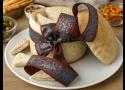
Ingrédients
Pâte
- 750 g de farine boulangère pour pain
- 485 g d'eau
- 30 g de levure de boulanger fraîche
- 15 g de sel fin
Garniture
- 200 g de fromage de brebis
- 2 tranches de jambon blanc
- 2 ou 4 tranches de jambon de Bayonne
- 200 g de beurre ramolli
- 200 g de beurre de roquefort
Instructions
- Pour réaliser cette recette de pain surprise, commencer par préparer tous les ingrédients.
- Verser le sel fin dans la farine. Mélanger et mettre en fontaine.
- Ajouter la levure de boulanger émiettée...
- ...et l'eau tiède.
- Mélanger au batteur (avec l'accessoire crochet) pendant 3 minutes à petite vitesse...
- ...puis poursuivre ce pétrissage pendant 8 minutes à vitesse moyenne. Stopper le pétrissage à ce stade.
- Retirer le crochet, former une boule de pâte...
- ...et couvrir d'un linge propre. Laisser pousser la pâte 20 minutes dans un endroit tiède, comme une chambre de pousse.
- Retirer le torchon...
- ...et rompre la pâte avec la paume de la main.
- Transvaser cette pâte dans un cercle à pain surprise légèrement graissé à l'aide d'un aérosol à graisse. Ce cercle sera également posé sur une plaque à pâtisserie à revêtement anti-adhérent.
- Couvrir d'un torchon propre et laisser lever à nouveau pendant 1h30 à 2h. Lorsque la pâte arrive à quelques centimètres du bord du cercle, retirer le torchon...
- ...et laisser pousser encore quelques minutes jusqu'à ce que la pâte dépasse du cercle et soit bombée sur le dessus.
- Enfourner dans un four ventilé (ou chaleur tournante), préchauffé à 200°C, et laisser dorer entre 30 et 40 minutes selon la grosseur du pain.
- Au terme de la cuisson, retirer le pain du four...
- ...et retirer le cercle en inox. Laisser refroidir.
- Avec un couteau à pain...
- ...découper le chapeau du pain délicatement.
- Remettre le pain droit et enfoncer la pointe d'un couteau filet de sole entre la mie et la croûte de façon verticale. Attention à ne pas transpercer le fond.
- Par un mouvement de haut en bas, découper la mie sur tout le pourtour du pain.
- Veiller à couper la mie jusqu'au fond, en le faisant le plus régulièrement et le plus droit possible, et surtout sans transpercer la croûte du fond.
- Retirer le couteau et le planter horizontalement à 1 cm de hauteur de la croûte du fond. Il est nécessaire de faire une entaille de 3 à 4 cm pour être à l'aise.
- Lorsque le couteau est enfoncé, le faire pivoter du côté tranchant, afin de couper le fond du pain surprise. Veiller à épouser le contour du pain, sans pour autant transpercer la croûte.
- Retirer le couteau, faire pivoter la lame et la réintroduire délicatement dans le même trou et renouveler la découpe du fond, toujours sans transpercer la croûte.
- Retirer le couteau et introduire délicatement la main à la verticale entre la mie et la croûte. Avec le bout des doigts, décoller totalement le bloc de mie de sa croûte. Faire de même sur tout le pourtour. Attention à ne pas l'abîmer.
- Retirer le bloc de mie et réserver la croûte et le chapeau.
- Découper au couteau à pain le bloc de mie en 8 tranches régulières, d'épaisseur égale. Attention à ne pas les casser.
- Beurrer la surface des tranches de mie.
- Disposer le jambon de Bayonne...
- ...et recouvrir d'une seconde tranche de mie. Presser pour bien faire adhérer et découper au ciseaux le jambon qui déborde sur le pourtour.
- Faire de même avec le beurre de roquefort...
- ...que vous aurez préparé préalablement et qui aura la consistance d'une pommade.
- Continuer avec du jambon blanc et enfin avec le fromage de brebis. Vous pouvez laisser marcher votre imagination pour trouver d'autres idées de garniture.
- Découper chaque galette de pain de mie garni...
- ...en 8 avec un gros couteau éminceur.
- Disposer les mini-sandwichs dans le pain de mie...
- ...afin de reconstituer le pain.
- Il est possible de faire un étage de chaque (un étage de jambon, un étage de roquefort, etc...) ou bien de mélanger toutes les variétés.
- Refermer le pain surprise avec son couvercle. Juste avant de le servir aux invités, parfaire sa présentation en l'entourant d'un ruban à charlotte. Bon appétit !
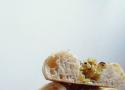
Ingredients
- 2 1/4 cups warm water (not more than 115F / 46C)
- 2 teaspoons sugar
- 2 1/4 teaspoons yeast
- 2 tablespoons shortening (only if you add onion to the dough)
- 1/3 cup sweet onion, finely chopped (I did not use onion in the dough)
- freshly ground black pepper, to taste
- 3 cups (approx 400 grams) bread flour
- 2 tablespoons canola oil (I used peanut oil)
- 1 cup sweet onion, finely chopped (I used white onions)
- 2 teaspoons poppy seeds
- 1 tablespoon salt
- 3 cups (approx 400 grams) bread flour
Instructions
- For the sponge: In a large glass bowl, whisk together the water, sugar and yeast and allow to stand about 5 minutes or until foamy. If using onions in dough: In a small saute pan over low heat, sweat 1/3 cup onion in shortening until it’s soft and translucent.
- With a wooden spoon, stir the flour and onion mixture into the yeast mixture. Stir for about 3 minutes then cover tightly with cling film and let stand about 90 minutes or until doubled and bubbly.
- For onion topping: Sweat remaining onion in canola oil with poppy seeds over low heat until translucent, set aside to cool.
- For the bialys: Preheat the oven to 500 F. Place an oven proof pan or baking tray in the bottom of the oven and your baking stone or heavy baking tray in the center.
- When the sponge is ready, add salt and 2 cups (approx 260 grams) bread flour and begin to knead the soft dough right in the bowl. Add as much flour as is needed to obtain a workable dough and knead until it’s soft and pliable, about ten minutes total.
- Cover the bowl tightly with cling film and allow to rise until doubled in bulk, about 90 minutes.
Divide the dough into 12 portions and shape each into a round about half an inch thick. Create a depression in the center and prick well with a fork. - Divide the onion mixture evenly between the breads and prick the centers again before baking.
Put ice cubes or cold water into the skillet or baking tray to create steam. Transfer the breads onto your baking stone or baking tray with a bit of cornmeal to prevent sticking. (I used a cookie sheet to help transfer the bialys onto a baking stone) - Bake ten minutes at 500 F, reduce temperature to 450 and bake a further 5 minutes or until golden brown. Cool on a wire rack
Ingredients
For the Sponge
- 1 cup milk
- 1/3 cup all-purpose flour
- 2 teaspoons sugar
- 1/2 cup lukewarm water
- 3 (1/4-ounce) packages active dry yeast
For the Dough
- 10 large egg yolks, room temperature
- 2 large eggs, room temperature
- 1 teaspoon salt
- 1 cup sugar
- 8 ounces (1 cup) unsalted butter, melted
- 2 teaspoons pure vanilla extract
- 1 tablespoon lemon zest, grated
- 6 cups all-purpose flour
- 1 cup raisins, light or dark, optional
- 1 large egg, room temperature
- 2 tablespoons milk, or water, room temperature
Instructions
Sponge
- Scald the milk and cool it to 110 F.
- Place 1/3 cup flour in a medium bowl and pour the cooled scalded milk over, beating until smooth. Set aside.
- In a measuring cup or small bowl, dissolve 2 teaspoons sugar in lukewarm water and stir in the yeast.
- Transfer the yeast mixture to the milk-flour paste, mixing well.
- Cover with plastic wrap and let rise until light and bubbly.
Dough
- In a large bowl or stand mixer, beat the egg yolks, whole eggs, and salt.
- Add 1 cup sugar and continue beating until light.
- Beat in the butter, vanilla, and lemon zest.
- Add the sponge to this mixture and mix well.
- Add 6 cups flour and knead 7 minutes by machine or 10 minutes by hand.
- Knead in the optional raisins.
- Cover with greased plastic wrap and let rise until doubled.
- Punch down dough, knead a few times, and let it rise again.
- Grease 3 babka cylinders or food-grade coffee tins and fill each pan 1/3 full.
- Cover with greased plastic wrap and let rise until tripled.
- Brush tops with 1 large egg beaten with 2 tablespoons of milk or water.
- Heat oven to 375 F.
- Bake babkas 10 minutes.
- Then lower temperature to 325 F and bake 30 minutes.
- Then lower temperature to 275 F and bake 15 to 20 minutes longer. Cover tops with aluminum foil, if they are browning too quickly.
- Remove from the oven and let stand in the pan for 10 minutes.
- Turn loaves out of the pan, running a knife around them, if necessary, and cool completely on a wire rack.
- If desired, the cooled loaves can be iced with a simple confectioners' sugar glaze, letting it drip down the sides for a decorative effect.
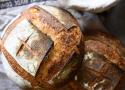

Ingredients
Dough
- 3 cups (360g) King Arthur Unbleached All-Purpose Flour
- 1 3/4 teaspoons (11g) table salt
- 1 teaspoon instant yeast
- 1 teaspoon granulated sugar
- 1 1/4 cups (284g) water, warm (90°F to 110°F)*
- 1 1/2 tablespoons (18g) olive oil
- 1/4 cup (35g) King Arthur Cinnamon Sweet Bits*
Pan and topping
- 3 tablespoons (36g) olive oil, divided
- 1/3 cup (71g) light brown sugar, packed
- 2 tablespoons (28g) butter, softened
- 1 tablespoon (5g) Vietnamese cinnamon
Glaze
- 3/4 cup (85g) confectioners' sugar, sifted if lumpy
- 1 1/2 tablespoons (21g) milk or heavy cream
- 1/2 teaspoon King Arthur Pure Vanilla Extract
- pinch of table salt
Instructions
- To make the dough: Weigh your flour; or measure it by gently spooning it into a cup, then sweeping off any excess. In a large bowl (a 3-quart bowl with a lid works great), whisk together the flour, salt, yeast, and sugar.
- Add the water and olive oil and stir — with a spatula, bowl scraper, dough whisk, or your hands — until the mixture is thoroughly combined and homogeneous; there should be no dry patches or lumps. Cover the bowl and set it aside for 15 minutes.
- Perform the first bowl fold: Use a wet hand to grab a section of dough from one side of the bowl, then lift it up and press it into the center. Repeat this motion, grabbing a new section of dough each time, until you’ve made a full circle around the bowl, about 8 to 12 times. Once you’ve circled the bowl, flip the dough over in the bowl so that the smooth side is up; the first bowl fold is now complete. Cover the bowl and let the dough rest for 15 minutes. Note: You’ll do this three more times over the next 45 minutes, strengthening the dough each time.
- Repeat the bowl fold for a second time. (Remember to use a wet hand to prevent the dough from sticking!) At this point, the dough should feel smoother and tighter. Cover the bowl and let the dough rest for 15 minutes.
- Sprinkle about half of the Cinnamon Sweet Bits (2 tablespoons or 18g) over the dough, then repeat the bowl fold for a third time, covering up the Cinnamon Sweet Bits as you fold. Cover the bowl and let the dough rest for 15 minutes.
- Sprinkle the remaining Cinnamon Sweet Bits over the dough, then repeat the bowl fold for a fourth and final time; the dough should feel relatively strong.
- Cover the bowl and let the dough rise at a warm room temperature (70°F to 75°F) for 1 hour; see this post, Where to put dough to rise, for tips. After 1 hour, the dough should have nearly doubled in size and will be very puffy; it may even have a few bubbles on the surface.
- To prepare the pan: Once the dough has risen, spray the bottom and sides of a 9" square Fabulous Focaccia Pan with nonstick spray. (See “tips,” below for details about this pan as well as alternate pan options.) Fully line the pan with parchment so that there’s some excess overhanging the edges. Lightly spray the parchment with nonstick spray, add 1 tablespoon (13g) of the olive oil, and tilt the pan to spread the oil evenly across the bottom.
- Use a bowl scraper or flexible spatula to gently transfer the risen dough to the center of the pan. Drizzle 1 tablespoon (13g) of the olive oil over the dough.
- Cover the pan and let the dough rise at a warm room temperature for 1 to 1 1/2 hours, until it’s marshmallowy and jiggly; the dough should nearly fill the corners of the pan and be very close to the top edge.
- While the dough rises, make the topping: In a small bowl, combine the brown sugar, butter, and cinnamon and mix until it forms a smooth, thick paste. Cover and set aside until the dough has risen.
- Toward the end of the rise, preheat the oven to 450°F with a rack in the lower third.
- Once the dough has risen, lightly coat your fingers in oil. Starting at one edge, press your fingertips into the dough until they reach the bottom of the pan, creating dimples. Repeat this process, working your way from one edge to the other, spacing the dimples about 1 1/2" apart. The goal is to thoroughly dimple the dough without deflating it — aim for decisive yet gentle motions. If there are any large untouched areas of the dough, add additional dimples using one finger.
- To top the dough: Use your hands to distribute the brown sugar mixture all over the dough, aiming to fill in many of the dimples. Dimple the dough once more, pushing the brown sugar mixture into the dough. Drizzle the remaining 1 tablespoon (13g) olive oil all over the surface of the dough.
- Bake the cinnamon roll focaccia on the lower rack for 15 to 20 minutes, until the topping is thick and bubbly and any exposed dough is deep golden brown. If the focaccia is browning too fast, tent it with foil after 15 minutes.
- Remove the focaccia from the oven. Using the parchment and a thin spatula for assistance, carefully transfer the focaccia to a wire rack to cool slightly.
- To make the glaze: In a small bowl, stir together the ingredients to make a smooth glaze; the consistency should resemble honey. Drizzle it all over the warm focaccia and allow it to set, 10 to 15 minutes.
- Cut into slices and serve the cinnamon roll focaccia slightly warm or at room temperature.
- Storage information: Focaccia is best enjoyed the day it's made. If storing leftovers, wrap the focaccia loosely in foil, keep it at room temperature, and reheat before serving.
C'est un peu long à faire mais c'est super bon.
Je ne suis pas sur que le glaçage soit nécessaire.
La prochaine fois je n'en mettrais pas.

Ingrédients
- 750 g de farine
- 43 cl (+/- 10) de lait frais
- 30 g de levure fraîche
- 100 g sucre
- 100 g de beurre
- 1 gros œuf fermier (60 g)
- 1 zeste de citron bio râpé
- 50 g raisins secs
- 25 g de rhum brun (facultatif)
- 12 g de sel
- 1 jaune d’œuf pour dorer
Instructions
- Si vous optez pour la version avec raisins secs au rhum, faire macérer les raisins quelques heures ou même la veille dans du rhum brun. En principe les raisins devraient complétement absorber l’alcool, qui lui, va complétement disparaître lors de la cuisson et ne laisser que les parfums.
- Dans le bol du pétrin, verser le lait tempéré à 20°C, ajouter la levure et la faire fondre.
- Verser la farine par-dessus ainsi que l’œuf et le sucre. Il est très important de ne pas mettre la levure en contact direct avec le sel, au risque de la détruire.
- Démarrer le pétrissage en 1ère vitesse pendant 2 à 3 minutes, jusqu’à ce que la pâte de forme puis ajouter le sel à ce stade
- Démarrer la 2ème vitesse et pétrir la pâte pendant 5 minutes jusqu’à ce que la pâte se décolle des bords du récipient. Cette opération permet de rendre la pâte élastique et de lui incorporer l’air nécessaire au développement de la levure.
- Puis est venu le moment d’ajouter le beurre. Le beurre doit être froid mais pas glacé, à température ambiante est le mieux, mais surtout pas liquide. L’ajouter par petites portions et continuer le pétrissage pendant 4 à 5 minutes ou jusqu’à ce que la pâte se décolle des bords du récipient et devienne lisse, souple et élastique.
- Si vous avez opté pour les raisins secs, au rhum ou pas rhum, c’est maintenant qui faudra les mettre et continuer le pétrissage pour encore 1 à 2 minutes.
- Lorsque le pétrissage est terminé, faire une belle boule avec cette pâte puis la réserver dans un grand bol, à couvert, pour le pointage à température ambiante, ceci pour 60 à 90 minutes, ce qui permet à la levure de commencer son action.
- Une fois la pâte bien développée, lui donner un rabat (la plier en 4) et la remettre dans le bol puis déposer le au réfrigérateur pendant une heure environ.
- Le temps étant écoulé, déposer la pâte sur le plan de travail et la diviser en deux parts, les bouler très légèrement et les laisser se détendre sous un torchon pendant 10 minutes.
- Reprendre les pâtons et les façonner en long, de la grandeur des moules, ici 25 cm.
- Les déposer dans les moules beurrés et farinés ou comme ici, recouvert d’un papier sulfurisé et les faire pousser dans un endroit chaud (28°C), recouverts d’une feuille plastique, pour une bonne heure de pointage. Il faut un développement maximal pour ce genre de gâteau.
- Préchauffer le four à 180°C, dorer les brioches avec de l’œuf battu, puis avec une paire de ciseau, les entailler profondément 5 à 6 fois afin d’obtenir les pointes caractéristiques des taillaules.
- Enfourner pour 30 à 35 minutes tout en surveillant régulièrement la cuisson et sitôt cuites, les démouler et les refroidir sur une grille.
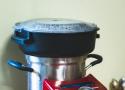
Ingrédients
- 300 g de farine de blé
- 50 g de farine de riz
- 1 sachet de levure boulangère sèche
- 20 cl de lait
- 70 g de sucre
- 3 cuillères à soupe d’huile neutre (pépins de raisin par exemple)
- de la pâte à tartiner chocolat noisette (ici gianduja)
Instructions
- Faites tiédir le lait avec le sucre jusqu’à dissolution.
- Quand le lait est tiède/chaud (non bouillant – 30/35°C – trempez votre petit doigt dedans, vous ne devez pas trop ressentir la chaleur), ajoutez-y l’huile (neutre en saveur et en couleur, pas comme ce que j’ai fait donc) et la levure de boulanger.
- Mélangez.
- Dans un grand saladier, mélangez les deux farines puis versez-y le lait tiède tout doucement en mélangeant délicatement avec les doigts.
- Travaillez la pâte jusqu’à obtenir une boule, enrobez-la de farine (pour éviter qu’elle ne colle au plat et favoriser son extraction plus tard) et laissez-la monter deux heures dans son saladier, recouvert d’un linge propre, dans un endroit chaud et à l’abri des courants d’air (enfermée dans votre four éteint par exemple)
- Une fois que la pâte à brioche a bien levée, étalez-la sur un plan de travail, préalablement fariné, à l’aide d’un rouleau à pâtisserie. Ni trop épaisse, ni trop fine.
- Munissez-vous d’un emporte pièce rond de 8 cm de diamètre (environ… ou un verre, ou un petit bol) et découpez des cercles jusqu’à épuisement de la pâte.
- Déposez une petite boule de gianduja au centre de l’un des rond de pâte, et repliez-la autour de la boule vers le haut petit à petit jusqu’à avoir fait le tour.
- Faites une sorte de « tourbillon » au moment de fermer la brioche pour solidifier la « soudure » (humidifiez un peu la pâte au besoin).
- Posez votre banh bao sur un carré de papier cuisson et procédez à la réalisation des autres jusqu’à épuisement de la pâte.
- Enfin, posez-les dans votre panier de cuiseur-vapeur, sans trop les coller et laissez-les cuire 10 à 15 minutes. Une fois cuit vos banh bao ont un peu gonflé et sont bien blancs.
- Servez rapidement après cuisson.
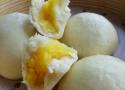
Ingrédients
Farce à la crème-œuf
- 1 œuf
- 30 g de beurre mou
- 35 g de sucre glace
- 20 g de custard powder
- 18 g de fécule de maïs
- 45 g de lait entier
Pâte
- 150 g de farine T 45
- 1,5 g de levure boulangère sèche
- 80 à 85 g d'eau tiède
- 10 g de sucre
- 1 pincée de sel
- 1 c. à café d'huile végétale
Instructions
Pâte
- Mélangez l'eau et la levure, laissez mousser pendant 5 à 10 min.
- Mélangez tous les ingrédients à sec, versez le mélange levure-eau petit à petit.
- Pétrissez pendant 5 min pour avoir une boule lisse et homogène.
- Ajoutez l'huile, pétrissez de nouveau.
- Laissez pousser dans un endroit doux (en couvrant d'un linge humide) et pas trop sec pendant 1 heure.
Farce
- À préparer de préférence la veille et conserver au frais.
- Battez l'oeuf.
- Mélangez le beurre mou avec du sucre, ajoutez l’œuf en plusieurs fois, mélangez bien entre chaque ajout d’œuf.
- Tamisez la fécule et la custard powder, ajoutez dans la préparation précédente, mélangez bien.
- Ajoutez du lait.
- Faites cuire ce mélange au micro-onde pendant 1 min 15, sortez toutes les 20 secondes pour bien mélanger.
- Passez au tamis pour avoir une texture plus fine (pas obligatoire).
- Réservez la farce au frais.
Pliage et cuisson
- Sortez la pâte, dégazez, formez en forme de boudin.
- Divisez en 6 morceaux équivalents.
- Abaissez chaque morceau en petite galette, le bord doit être plus fin que le centre.
- Mettez une belle c. à café de farce au centre de la galette, pliez pour avoir la forme d'un baozi.
- Placez les petits pains dans la panier vapeur, côté plis vers le bas.
- Laissez pousser pendant 30 à 40 min.
- Mettez le panier sur une casserole ou un wok pré-rempli d'eau froide.
- Faites cuire à la vapeur pendant 12 min à partir d'ébullition (départ d'eau froide).
Ingredients
- 400g bread flour (14 ounces; about 2 1/2 cups), plus more for dusting
- 10 g kosher salt (0.35 ounces; about 2 teaspoons), plus more for sprinkling
- 4 g instant yeast (0.15 ounces; about 1 teaspoon), such as SAF Instant Yeast
- 275 g water (9.5 ounces; about 1 cup plus 3 tablespoons)
- 8 g extra-virgin olive oil (0.25 ounces; about 2 teaspoons), plus more to coat pans and for drizzling
- 1 1/2 cups pizza sauce, such as our New York–style pizza sauce
- 12 ounces grated full-fat, low moisture (dry) mozzarella cheese (see note)
- Toppings as desired
- Small handful torn fresh basil leaves (optional)
- 2 ounces grated Parmesan or Pecorino Romano cheese (optional)
Instructions
- Combine flour, salt, yeast, water, and oil in a large bowl. Mix with hands or a wooden spoon until no dry flour remains. (The bowl should be at least 4 to 6 times the volume of the dough to account for rising.)
- Cover bowl tightly with plastic wrap, making sure that the edges are well sealed, then let rest at cool room temperature (no warmer than 75°F or 24°C) for at least 8 hours and up to 24. Dough should rise dramatically and fill bowl. In a hot kitchen, the dough may overproof near the end of that range.
- Sprinkle top of dough lightly with flour, then transfer it to a well-floured work surface. Divide dough into 2 pieces and form each into a ball by holding it with well-floured hands and tucking the dough underneath itself, rotating it until it forms a tight ball.
- Pour 1 to 2 tablespoons oil in the bottom of two 10-inch cast iron skillets or round cake pans (see note). Place 1 ball of dough in each pan and turn to coat evenly with oil. Using a flat palm, press dough around the pan, flattening it slightly and spreading oil around the entire bottom and edges of the pan. Cover tightly with plastic wrap and let dough sit at room temperature for 2 hours (at room temperatures above 75°F or 24°C, the dough may require less time to rise; at temperatures below 65°F or 18°C, it may require more time). After the first hour, adjust an oven rack to the middle position and preheat oven to 550°F (290°C).
- After 2 hours, dough should be mostly filling the pan up to the edges. Use your fingertips to press it around until it fills in every corner, popping any large bubbles that appear. Lift up one edge of the dough to let any air bubbles underneath escape, then repeat, moving around the dough until there are no air bubbles left underneath and the dough is evenly spread around the pan.
- Top each round of dough with 3/4 cup sauce, spreading sauce to the very edge with the back of a spoon. Sprinkle evenly with mozzarella cheese, all the way to the edges. Season with salt. Add other toppings as desired. Drizzle with olive oil and scatter a few basil leaves over the top of each pizza, if desired.
- Transfer pan to oven and bake until top is golden brown and bubbly and bottom is golden brown and crisp when you lift it with a thin spatula, 12 to 15 minutes. Immediately sprinkle with grated Parmesan or Pecorino Romano cheese, if using. Using a thin spatula, loosen pizza and peek underneath. If bottom is not as crisp as desired, place pan over a burner and cook on medium heat, moving the pan around to cook evenly until it is crisp, 1 to 3 minutes. Remove the pizzas and transfer to a cutting board. Cut each pizza into 6 slices and serve immediately.

Ingrédients
- 580g de farine T65 + 1 CS bombée de gluten
- 170g de lait
- 170g d'eau
- 1 oeuf
- 3 CS d'huile d'olive
- 1 sachet de levure sèche de boulanger (8g) délayée dans une CS d'eau tiède
- 1 CC sel
- 1 CS miel
- 1 rizhome de curcuma fraîchement râpé
- des petites graines au choix, légèrement torréfiées (poêlées pendant 15 mn feu moyen, ou four à 170° 10 mn): sésame, courge, tournesol, lin
Instructions
- Déposez les éléments liquides dans la cuve du robot en terminant par la levure délayée préalablement dans 1 CS d'eau tiède.
- Versez les solides par dessus, ajoutez le curcuma, en le râpant à l'aide d'une microplane par exemple.
- Pétrissez au crochet pour obtenir une pâte à la robe jaune homogène, pas trop longuement, 5 minutes suffisent pour obtenir une masse souple un peu collante.
- Couvrez d'un film à même la pâte (elle ne doit pas croûter!), et laissez pousser dans un endroit tiède, sans courants d'air. Une poussée lente, à l'extérieur est préférable à une accélération de la chaleur dans un four, il y a moins de risques de développer une acidité excessive. Si vous avez cependant une forte odeur de levure malgré "une poussée extérieure", ajoutez à votre pâte du jus de citron et un demi zeste...ou bien changez de levure, pour une de meilleure qualité.
- Lorsque la pâte a poussé, appuyez dessus fortement pour chasser l'air. Farinez légèrement un plan de travail (on ne doit pas trop intégrer de farine à présent aux buns!) déposez la pâte, coupez-là en dix morceaux égaux, façonnez-les en boules, en marquant une soudure qui sera le "dessous", si ça colle tant pis, ne refarinez surtout pas vos mains, vos buns doivent rester légers !
- Déposez vos pâtons sur une plaque à biscuits de cuisson (perso je les mets sur deux plaques vierges, ni feuille de cuisson, ni badigeon d'huile qui "croûterait" le dessous des pains, ils doivent rester parfaitement moelleux) antiadhérentes par contre...et ce, de manière espacée et en quinquonce. Recouvrez d'un film alimentaire, pour ne pas faire croûter le dessus des pains. Laissez sur un plan de travail, dans un endroit tiède.
- Préchauffez votre four T 200° sans rien à l'intérieur, surtout pas la grille qui va recevoir vos buns, vous cuiriez le dessous des petits pains beaucoup trop rapidement !
- Dans un bol, délayez 1CS d'eau avec 1 CC de miel, une fois bien diluée, imbibez un petit chiffon propre du liquide. Lorsque les pains ont doublé de volume, enlevez le film et "mouillez" le dessus des buns, parsemez enfin avec vos graines favorites.
- Déposez votre plaque à buns sur une grille parfaitement froide, ajoutez un ramequin d'eau bouillante au milieu des pains, ceci afin qu'il y ait une ambiance légèrement humide dans le four et enfournez pour dix minutes ! Pas plus. C'est près !
- Attendre qu'ils soient totalement refroidis avant de les congeler ou dégustez avec vos garnitures préférées.
- Si on le désire on peut au bout de 30 minutes, couper les pains en deux et les toaster légèrement côté mie.
Les pains sont très moelleux par contre le goût du curcuma n'est pas nécessaire si l'on utilise des ingrédients forts en saveurs dans la garniture.
À refaire sans le curcuma et voir ce que ça donne.
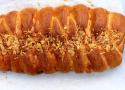
Ingredients
Dough
- 455 grams (3 1/2 C) unbleached all purpose flour
- 2 1/4 tsp instant yeast
- 1 tsp sugar
- 1 1/4 tsp salt
- 1/2 cup water
- 1/4 cup milk
- 1/4 cup vegetable oil
- 2 large eggs
- 2 large egg yolks
Filling and Topping
- 1 tbsp butter
- 1 tbsp olive oil
- 1 large red onion, halved and thinly sliced
- 6 large shallots, thinly sliced
- 1 tsp sugar
- 1 tbsp herbes de Provence, plus more for sprinkling (mine is from The Spice House)
- 6 ounces grated Gruyere cheese, plus another ounce for sprinkling
- 1 tbsp Dijon mustard
- 1 egg, beaten with 1 T water
Instructions
- Whisk the dry ingredients of the bread in the bowl of a stand mixer.
- Whisk the water, milk, eggs, and egg whites together in a bowl and add to the dry ingredients.
- Mix with the dough hook for about 10 minutes on medium low speed.
- Place the dough into an oiled bowl, cover, and allow to rise until doubled, about an hour.
- While the dough is rising, prepare the onion filling. In a 12 inch skillet, melt the butter and olive oil.
- Add the onions, shallots, and sugar, and cook for about 5 minutes on medium heat. Add the herbs and continue to cook, stirring regularly, for about 20 minutes more, until caramelized.
- When the dough has doubled, place it on a piece of baking sheet sized piece of parchment paper.
- Roll it out to a 12 inch by 11 inch rectangle.
- Spread the mustard lengthwise in the middle of the dough into a 3 inch line.
- Spread the onion mixture over the mustard.
- Sprinkle the 6 ounces of cheese over the onion mixture.
- Using a sharp knife, make diagonal 1 inch cuts on both sides of the stripe of onion and cheese mixture.
- Lift the parchment with the loaf onto a baking sheet.
- Fold the ends over the filling, and then fold the strips over the filling, alternating from both sides, so that the top of the dough looks like a braid.
- Preheat the oven to 350 degrees F.
- Cover the loaf loosely with oiled plastic wrap and let it rise until doubled, about 30 to 40 minutes.
- Brush the top of the loaf with the egg wash.
- Sprinkle the center of the braid with about an ounce of grated Gruyere.
- Sprinkle the top of the cheese lightly with herbes de Provence.
- Bake the loaf for about 45 minutes, until nicely browned and the center registers about 190 degrees F.
- Cool on a wire rack. Serve warm, or cool completely and wrap in foil to serve later.
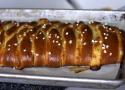
Ingredients
Sponge
- 6 tablespoons (3 ounces) warm water
- 1 teaspoon sugar
- 1 1/2 teaspoons instant yeast
- 1/4 cup (1 ounce) unbleached all-purpose flour
Dough
- Sponge (above)
- 6 tablespoons (3 ounces) sour cream or yogurt
- 1/4 cup (4 tablespoons or 2 ounces) unsalted butter, softened
- 2 large eggs, 1 beaten for dough, 1 beaten with 1 teaspoon water for brushing bread
- 1/4 cup (1 3/4 ounces) sugar
- 1 teaspoon salt
- 1 teaspoon vanilla extract
- 2 1/2 cups (10 5/8 ounces) unbleached all-purpose flour
- Pearl sugar* or sparkling white sugar for sprinkling
Lemon cream cheese filling
- 1/3 cup (2 1/2 ounces) cream cheese, softened
- 2 tablespoons (5/8 ounces) sugar
- 2 tablespoons (1 ounce) sour cream
- 1 teaspoon fresh lemon juice
- 2 tablespoons (1/2 ounce) unbleached all-purpose flour
- 1/4 cup (2 ounces) homemade (recipe below) or prepared lemon curd
Instructions
Sponge
- In a small bowl, combine the sponge ingredients.
- Stir well to combine, loosely cover with plastic wrap, and set aside to proof for 10 to 15 minutes.
Dough in a stand mixer
- Combine the sponge, sour cream, butter, egg, sugar, salt and vanilla in the bowl of a stand mixer.
- Add flour and mix with the paddle attachment until the dough is a rough, shaggy mass.
- Switch to the dough hook and knead on until a soft, smooth dough forms, about 5 to 6 minutes.
- Place the kneaded dough in a lightly greased bowl, cover with plastic wrap, and allow to rise for 60 to 90 minutes, until quite puffy and nearly doubled.
Dough by hand
- Whisk together sour cream, butter, egg, sugar, salt and vanilla in a large, wide bowl.
- Stir in sponge.
- Add the flour and mix with a wooden spoon as best as you can; you may need to get your hands in there to form it into a shaggy ball.
- Turn ball of dough and any incorporated scraps onto a counter and knead until a smooth, soft dough forms, about 5 to 10 minutes.
- Place the kneaded dough in a lightly greased bowl, cover with plastic wrap, and allow to rise for 60 to 90 minutes, until quite puffy and nearly doubled.
Filling
- Combine all the filling ingredients (except the lemon curd) in a small bowl, mixing until smooth and lump-free.
- Reserve the filling and lemon curd until ready to fill the braids.
Bread
- Gently deflate the dough and roll it out on a very well floured counter to a 10″ x 15″ rectangle.
- Transfer rectangle to a large piece of parchment paper, please; I did not and it led to all sorts of trouble.
- With the side of your hand, lightly press two lines down the dough lengthwise, dividing it into three equal columns.
- Spread the cream cheese filling down the center section, leaving the top and bottom two inches free of filling.
- Spread the lemon curd over the cream cheese filling.
- To form the mock braid, cut crosswise strips one inch apart down the length of the outer columns of you dough (the parts without filling).
- Make sure you have an equal amount of 1-inch strips down the right and left sides.
- Be careful not to cut your parchment paper; if you have a bench scraper, this is a great time to use it.
- Remove the four corner segments.
- To “braid”, begin by folding top flap down and bottom flap up over the filling.
- Lift the top dough strip and gently bring it diagonally across the filling.
- Repeat on the right side, and continue down the entire braid, alternating strips until you are out.
- You can tuck the last couple that hand off decoratively under the end of the braid.
- Carefully transfer the dough and the parchment paper to a baking sheet.
- Cover loosely with plastic and set it aside to rise for 45 to 50 minutes, until quite puffy.
- Preheat the oven to 375°F.
- Brush the loaves with egg wash, and sprinkle with pearl or coarse sparkling sugar.
- Bake for 25 to 30 minutes, or until the loaves are golden brown and your apartment smells like a doughnut factory.
- Remove from the oven and cool for 15 to 20 minutes before serving.