C'est bon, mais c'est à faire sporadiquement car c'est TRÈS riche.


Je l'ai fait en réduisant la quantité de cardamome (une demi cuillère à café au lieu d'une demi cuillère à soupe) car je trouvais que ça sentait fort quand je l'ai moulue.
Après l'avoir gouté, je pense que la proportion est la bonne dans la recette car ça ne sentait pas du tout une fois cuit.

C'est excellent mais attention aux odeurs. La cuisson révèle toute la force du fromage.
En bouche, le gout est plus délicat !
À refaire sans hésiter.
Attention ! En suivant le temps indiqué, il manque légèrement de cuisson au centre du pain. Cependant, il était déjà bien bruni sur le dessus. Il faudra le couvrir de papier aluminium pour continuer la cuisson sans brûler le dessus.
Ingredients for the dough
- 1 pkg. Red Star Platinum yeast
- ¼ Cup warm water
- 1 Cup warm milk
- 3 ¼- ½ Cup unbleached, all-purpose flour
- 1 tsp. salt
- ¼ tsp. coarse ground pepper
- 2 Tbsp. butter, softened
- 1¼ Cup finely shredded Asiago cheese
Ingredients for the topping
- 1 egg, well-beaten
- ¼ Cup finely shredded Asiago cheese
Instructions
- Place warm water and yeast in EZ DOH bucket and stir to dissolve yeast. Let rest 1 minute.
- Add one cup of flour, then additional dough ingredients.
- EZ DOH-it for 2-3 minutes, or until dough is smooth and soft and all ingredients are incorporated, adding additional flour, as necessary, if the dough is too sticky.
- Remove dough from bucket, spray bucket with cooking spray, “smooth” dough and replace in bucket.
- Cover and let rise until doubled.
- Punch down the dough and remove it from the bucket.
- Form into one large French-style loaf, or two smaller loaves.
- Place on a lightly-greased baking sheet or in two smaller lightly-greased loaf pans.
- Cover with a clean dishtowel and let rise until doubled, usually 30-45 minutes.
- Preheat oven to 375°F.
- Lightly “slash” the tops of the loaves with a sharp serrated knife.
- Brush the tops with the beaten egg, then sprinkle with the cheese.
- Bake for 30-35 minutes, or until lightly browned.
- Remove from pan and let cool on a wire rack. ENJOY!!!
Je viens de découvrir cette boisson et c'est vraiment délicieux.
Il ne me reste plus qu'à essayer.
Une autre recette pour comparer
Edit : J'ai essayé, c'est bon mais comme ça laisse beaucoup de pulpe de riz, je ne suis pas sur de recommencer.
Edit : Finalement, j'ai utilisé le riz broyé pour faire des galettes. C'était vraiment bon !

C'est vraiment une bonne combinaison de saveurs. En plus, ça me permet d'utiliser mon caroube que je trainais depuis quelques années.
À refaire !
Ingrédients
- 75 g de noix de Grenoble décortiquées
- 8 à 10 dattes moelleuses (selon goût)
- 2 cuillers à soupe de caroube en poudre
- eau
Instructions
- Mettre les noix dans un bol. Couvrir d'eau fraîche. Laisser tremper 8 h.
- Égoutter les noix. Dans un petit mixer, combiner les noix avec 10 cl d'eau. Réduire en crème plus ou moins fine selon que vous préférez une pâte à tartiner onctueuse ou truffée de pépites croquantes.
- Ajouter les dattes dénoyautées. Mixer à nouveau. Ajouter enfin la poudre de caroube. Mixer une dernière fois.
- Verser la pâte dans un petit bol et conserver au réfrigérateur 5 jours maximum.

Une recette toute simple et très bonne. Je l'ai faite avec des champignons à la place des olives et j'ai utilisé les restes de fromages.
Miam !
Ingrédients
- 200 g de lardon fumé découenné
- 200 g de farine
- 200 g d'olives vertes dénoyautées coupées en petits dés
- 4 œufs
- 150 g de gruyère rapé
- 8 c. à s. de lait
- 75 g de beurre fondu
- 1 sachet de levure chimique
- Sel ou sel fin
- Poivre
Instructions
- Préchauffer le four chaud, thermostat 7 (210°C).
- Dans un saladier faire un puits avec la farine et la levure. En mélangeant avec une spatule, ajouter un à un les œufs, le beurre fondu, le lait, le gruyère. Assaisonner et incorporer les lardons et les olives.
- Mélanger. Beurrer un moule à cake et verser l'appareil. Cuire 40 minutes.
- Laisser refroidir 10 minutes et démouler.
- 3 cups flour
- 1 tablespoon baking powder
- 1 teaspoon salt
- 1 teaspoon garlic powder
- 1 teaspoon cayenne
- 1 teaspoon cumin
- 1 teaspoon jalapeno powder (substitute with smoked paprika)
- 2 tablespoons sugar
- 2 1/4 cups grated sharp cheddar cheese
- 12 ounces beer (dark ale or porter/stout. No lager) (1 bottle)
- 1/4 cup melted butter
- Preheat oven to 350 degrees Fahrenheit
- Mix all ingredients except butter and 1/4 cup of cheese in a big bowl
- Mix well. Grease 9x5 bread pan and place dough in the pan
- Cover top with melted butter and remaining cheese
- Bake for 50 minutes to an hour and enjoy.
I will be adding fresh diced jalapenos to the next batch for some extra flavor and texture.
Edit : c'est vraiment très bon. Malheureusement, c'est aussi addictif.
Pour utiliser le pain rassis.
Edit : c'est très bon et très facile à faire. Comme le pain était sec et non pas rassis, j'ai du ajouter plus de lait et laisser tremper le pain plus longtemps.
Ingrédients
- 500 g de pain rassis
- 1 litre de lait
- 150g de sucre de vergeoise ou de cassonade
- 3 œufs
- Un peu de beurre pour le moule
- 2 poignées de raisins secs qui ont macéré 1h dans le rhum
Instructions
- Faire chauffer le lait et le sucre.
- Coupez le pain en morceaux, le mettre dans un saladier et verser le lait bouillant dessus. Bien mélanger et laisser reposer 1 h.
- Une fois le pain bien reposé et tiédi, ajouter les œufs. Bien mélanger. Ajouter enfin les raisins.
- Versez ma pâte dans un moule beurré. Préchauffez le four à 180°C et cuire le pudding 1h.
- Servir froid.
Recette de nos locataires.
Ingrédients
- 1 tasse de farine tout usage non blanchie
- 2 tasses de flocons d'avoine à cuisson rapide
- ½ c. à thé de bicarbonate de soude
- Une pincée de sel
- ¾ de tasse de beurre à température ambiante (170 grammes)
- 1 tasse de cassonade
- ¼ de tasse de sucre
- 2 c. à soupe d'espresso ou de café noir
- 1 c. à thé d'extrait de vanille
- 1 œuf
- ½ tasse de chocolat noir fondu
Instructions
- Préchauffer le four à 375°F. Tapisser une plaque à pâtisserie de papier parchemin et réserver.
- Dans un bol, combiner la farine, les flocons d'avoine, le bicarbonate de soude et le sel. Réserver.
- Dans un autre bol, crémer le beurre, la cassonade et le sucre au batteur électrique (ou batteur à la main).
- Ajouter l'espresso, l'extrait de vanille et l’œuf, puis bien mélanger. Incorporer graduellement les ingrédients secs.
- À l'aide d'une cuillère à crème glacée d'une contenance de ¼ de tasse (environ...), façonner 12 boules, puis les disposer sur la plaque. Avec les doigts, presser les boules de manière à former des petites galettes de ½ pouce.
(Personnellement, je fais les boules à la main. Ça colle un peu, mais je trouve cela plus facile à travailler.) - Enfourner pendant 13 minutes, puis laisser refroidir complètement sur la plaque.
- Tremper chaque biscuit jusqu'au tiers dans le chocolat noir, laisser refroidir et déguster.
Note : il faut faire attention à espacer les biscuits avant la cuisson car ceux-ci s'étalent.
Recette trouvée dans le journal Metro de Montréal (12 janvier 2015)
Edit : testé et approuvé. J'ai utilisé du miel de sarrazin pour plus de goût et malgré cela, le goût du miel est assez ténu. À refaire !
Ingrédients
- 3 cuillères à soupe de gros sel
- 3 cuillères à soupe de moutarde à l'ancienne
- 3 cuillères à soupe de miel de trèfle
- 1 filet de saumon entre 750g et 1kg
Instructions
- Bien mélanger le sel, la moutarde et le miel dans un bol. Réserver.
- À l'aide d'un couteau bien aiguisé, retirer la peau du filet de saumon.
- Préparer un grand rectangle de pellicule plastique. Avec une cuillère, recouvrir un côté du filet à l'aide de la moitié de la préparation de miel et moutarde. Bien frotter avec la cuillère afin que toute la surface soit enduite du mélange.
- Déposer le filet au milieu de la pellicule plastique, côté enduit vers le bas. Répartir le reste de la préparation sur l'autre côté du saumon. Bien frotter. Replier les côtés de la pellicule plastique sur le poisson.
- Emballer le filet hermétiquement avec une autre pellicule plastique et s'assurer qu'il n'y a pas de bulle d'air.
- Déposer dans une assiette et recouvrir d'un poids. Mettre au réfrigérateur. Après 24 heures, retourner le filet. Reposer le poids et remettre au réfrigérateur durant 24 heures.
- Bien rincer le saumon à l'eau froide. Assécher à l'aide d'essuie-tout. Trancher pour servir.

C'est bon, c'est facile mais je ne trouve pas cette recette exceptionnelle. Je ne pense pas la refaire.
Je lui préfère d'autres recettes.
Ingrédients
- 300 g de farine
- 3 œufs
- 200 g de beurre mou, pas fondu
- ½ cube de levure de boulanger (délayée dans un peu d'eau tiède avec une noisette de beurre)
- 1 càs de sucre
- 1 pincée de sel
Instructions
- Tout mélanger (facile, surtout si on a un robot)
- Couvrir et mettre au réfrigérateur pour la nuit
- le lendemain, l'étaler comme une pâte à tarte puis la rouler comme un biscuit roulé. Découper des grandes tranches et les disposer debout dans un moule (à soufflé ou à kouglof par exemple).
- faire bouillir une casserole d'eau. Eteindre le feu. Poser une volette (grille) sur la casserole, et poser le moule sur la volette. Laisser lever.
- quand elle est bien gonflée, enfourner la brioche (départ four froid) et cuire pendant 25 minutes à 210°C (mettre du papier alu quand vous trouvez la brioche suffisamment dorée).
Je n'ai pas fait le pain dans un moule. Je l'ai tressé avec 4 brins.
Ce pain n'a pas beaucoup de tenue et aurait mérité un passage au moule. La tresse s'est un peu étalée.
Mais le résultat est très bon et très intéressant par rapport aux ingrédients utilisés.
Ingredients
- 500 g King Arthur All-Purpose Flour
- 205 g Unsweetened Coconut Milk
- 70 g (1 large) Egg
- 10 g Osmotolerant Instant Dried Yeast
- 5 g Salt
- 120 g Light Agave Nectar
- 55 g Virgin Unrefined Coconut Oil
- 4 tsp. Vanilla Extract
- Egg wash, as needed
Instructions
- Into the bowl of a stand mixer is placed the flour, yeast and salt.
- In a separate bowl is placed the egg, agave nectar, vanilla extract and coconut milk.
- The liquid mixture is then beat with a whisk until smooth.
- This liquid is then added to the flour mixture and the combined ingredients are mixed using the stand mixer on speed 2 until all the ingredients are incorporated, about 2 minutes.
- The mixer speed is then increased to speed 3 and the dough is given an intensive mix until a smooth windowpane can be drawn, about 10 minutes.
- The mixer speed is then reduced to speed 2 and the coconut oil is added.
- The mixing is continued until all the coconut oil has been incorporated into the dough, about 10 minutes.
- During this time, it may be necessary to stop the mixing and fold the dough over a few times by hand to facilitate the coconut oil incorporation.
- The dough is then placed in a lightly coconut oil-greased container, covered and allowed to ferment at 76ºF for 1 hour.
- The dough is then divided into 4 pieces, each piece pre-shaped into short logs and the pieces then allowed to rest at room temperature, covered, for 10 minutes.
- The dough pieces are then shaped into 10 inch long strands.
- Two strands are twisted around each other and then placed in a lightly coconut oil-greased 8½”x4½” bread pan.
- The second two dough strands are treated in the same way. Both pans are then covered with Saran QuickCovers and allowed a second fermentation of 1 hour at 76ºF.
- The pans are then uncovered, the loaves brushed with egg wash, and the pans loaded into a 375ºF oven.
- The loaves are allowed to bake for 30 minutes until mahogany brown, the first 10 minutes being under steam.
- When the loaves have finished baking, they are immediately removed from their pans and allowed to cool on a wire rack before slicing.
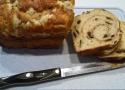
J'ai omis le glaçage et je n'ai fait qu'une demi recette.
Ingredients for the dough:
- 1 cup raisins and enough water to cover the raisins
- 1 cup warm water
- 1 tablespoon active dry yeast
- 1 cup 1% milk
- ¼ cup unsalted butter, melted
- 2 teaspoons kosher salt
- 6 cups all-purpose flour (plus more if needed)
Ingredients for the filling:
- ¾ cup granulated white sugar
- 2¼ tablespoons cinnamon
- 1 large eggs beaten with 2 teaspoons water
Instructions
- Put the raisins in a small bowl and cover with warm water and let rest for at least 10 minutes
- Drain the raisins (I patted them with a paper towel to remove the extra moisture), toss with a small amount of flour to coat, and set aside
- Place 1 cup warm water into the bowl of a standing mixer fitted with a dough hook
- Sprinkle the yeast over the water
- Stir to dissolve the yeast
- Let stand for about 10 minutes or until foamy
- Stir the milk, butter, and salt into the water and mix on low for a few seconds to combine
- Add the flour and stir to form a loose dough
- Knead with the mixer on low speed for about 8-10 minutes to form a smooth (but still slightly sticky dough)
- If it's very sticky or wet, add a little more flour until it starts to form a ball of dough
- Gradually add the raisins to the dough with the mixer on low and continue needing until they are evenly combined into the dough
- Cover the dough with plastic wrap and let rise in a warm place until doubled in size, about 1 hour
- Line two loaf pans with parchment paper and butter the parchment
- Combine the sugar and cinnamon in a small bowl
- Divide the dough into two pieces and set one aside
- Roll the first piece out on a cutting board or your (clean) counter
- It should be a little less wide than your baking pan and as long as possible
- Brush the surface of the dough with egg wash
- Sprinkle evenly with half of the cinnamon sugar
- Roll up the dough, starting with the end closest to you
- Transfer to one of the pans, seam side down
- Repeat with the other half of the dough
- Brush the tops of both loaves with egg wash and sprinkle additional cinnamon sugar over the top
- While you preheat the oven to 375 degrees, let the loaves rise for 45 minutes
- When the loaves have risen and the oven is preheated, bake the loaves for 40-45 minutes until golden brown
- Allow to cool and then remove the loaves from the pan

Je n'ai pas suivi exactement la recette.
D'abord, j'ai divisé la quantité de sel dans la pâte par deux. Ensuite, j'ai omis le glaçage au beurre et à l'oeuf ainsi que le saupoudrage de sel.
Le résultat est très satisfaisant. La pâte est élastique et dense. Ça rappelle un peu les bagels.
C'est à refaire !
La technique de mise en forme est expliquée ici
Ingredients
- 1 Tablespoon Sugar
- 2 Teaspoons Kosher Salt
- Sea-salt or Pretzel Salt (for sprinkling on top of pretzels)
- ⅔ Cup Baking Soda
- 1 Packet of Active Dry Yeast
- 4 cups of Bread Flour
- 6 Ounces of Unsalted Butter
- Olive Oil
- 1½ cups milk
- 10 Cups Water
- 1 Egg
Instructions
- Get your saucepan out. Measure and pour into the saucepan 1½ cups of milk (note you can use water instead but I think the milk makes tastier dough). Put it on your gas/electric stove top on medium low heat. Heat the milk until it reaches about 110°F (about when milk starts to steam), but turn off the heat right away so the milk does not boil over and move it off the burner. Its important to not have the milk too hot because it will kill the yeast but at the same time it needs to be warm enough to activate the yeast.
- Next get a big bowl out. Add 1 tablespoon of sugar and 2 teaspoons kosher salt to the bowl. Next pour in the milk. Now cut open the dry yeast packet and sprinkle the contents on top of the mixture. Let it sit for about 5 minutes, you will see it start to foam up.
- While you are waiting for the yeast milk mixture cut out 2 ounces butter and melt it. I used the same saucepan from before to melt the butter but you can just microwave it for 30 seconds or so instead if you prefer that method.
- After the 5 minutes are up then add the melted butter to the yeast milk mixture. Next measure and add the 4 cups of bread flour to the mixture as well. Now take a mixing spoon and start mixing.
- Mix the dough until it becomes well combined, smooth and begins to pull away from the side of the bowl, about 4 minutes. If the dough feels too dry then add a splash of water and continue mixing until it becomes smooth, it should look somewhat like the picture above. Note if you have a stand mixer then you can use that to mix the dough with the dough hook attachment at medium speed instead, but I had no problem doing it by hand.
- Next use your mixing spoon to push the dough from the large bowl into another bowl. I just used the saucepan I used to melt the butter from before. Now either get a new large bowl or clean the one the dough was created in, I just cleaned out the large dough bowl from before and dried it with a paper towel. Now take your olive oil (vegetable oil works too) and pour some on a paper towel then oil up the inside of your bowl.
- Remove and return the dough from the saucepan to the well oiled big bowl.
- Get your plastic saran wrap out and cover/seal the top of the bowl. Place the dough and the bowl in a warm dry place while the dough rises. I put mine by the radiator. Now set a timer and wait 55 minutes, it should at least double in size.
- While waiting for the dough to rise get out a medium pot. Measure and add 10 cups of water to the medium pot. Also measure out ⅔ a cup of baking soda but do not add it yet to the pot of water, just put it aside for now.
- When there is about 5 minutes left until the dough completely rises move the pot to the stove and turn on the burner on high. Then pour in the baking soda and grab a mixing spoon to combine it with the water. It should become a cloudy mixture. Leave the burner on for now and cover the pot with a lid because we will need it later for dunking the pretzels when the water reaches a rolling boil.
- When the pretzel dough has finished rising for its 55 minutes and has doubled in size then remove the plastic wrap and bring over to your kitchen work surface. Also bring over your olive oil and a large cutting board. Use the olive oil and a paper towel to oil the surface of your cutting board. Then simply plop out the dough onto the oiled surface of the board.
- I know it is really tempting to start playing with dough but before you start shaping the dough and creating the iconic pretzel shape first get out two cookie sheet pans then lightly oil them up with olive oil, Pam, vegetable oil or your preferred cooking method to prevent dough from sticking during the baking process. I actually used a Silpat mat on one pan and oiled the other with a quick spray of Pam. You will need the pans to hold the pretzels for the next few steps as well as for the baking process.
- Now here comes the fun part. Take the olive oil and pour some in your hands and rub them together. Now take your big mound of dough and split it up into about fist sized balls, I got 9 balls out of my dough. Next return all but one of the dough balls to your oiled bowl because unless you have a really large cutting board you will not be able to roll out all the pretzels. Be sure to look at the pictures if you are feeling confused because I tried to make it as easy as possible visually to follow each step in making the dough into the pretzel shape.
- Take that ball of dough left on the cutting boards and start rolling out into a long strip/rope of dough. Work and roll the dough back and forth from the center out to push the dough evenly across both ends. Stop when you have a piece about 2 feet long.
- Take the 2 ends of the dough strip and create a large U-shape. Then take the ends and curl them inward so they meet at the center.
- Then take the two ends of the strip and cross them over each other. Then pull them up and over the bottom of the U-shape curling the ends over the top and pressing them up into the bottom of the dough that makes the lower part of the U-shape.
- Congratulations you've made a ball of dough into the shape of a pretzel. Now move that dough pretzel onto one of the pans and do the same for the rest of the balls of dough.
- By the time you finish transforming all the dough balls into pretzel form the water should have reached a rolling boil. If not then wait until the water comes to a boil before doing anything else. Once boiling, preheat the oven to 450°F.
- Bring your pans of uncooked pretzels over by your boiling baking soda water and get out the spatula (the bigger the spatula the better). Scoop up one pretzel with the spatula and carefully lower it into the boiling water for 30 seconds. I set a timer for this part because if you leave the pretzels in the bath for too long then they will get soggy and will taste funny. Remove your spatula and use it to dunk the pretzel below the surface to make sure all of it gets covered with the water. When the 30 seconds is about to run up then take the spatula, position it underneath the pretzel and lift it out gently at the 30 second mark. Place the pretzel down on the pan it came from and repeat the process for each unbaked pretzel.
- Note if while you are bathing your pretzels you happen to drop it while taking it out of the pot and it breaks apart into bits inside the boiling water then use tongs to pull out the broken pieces. Then use your hands to shape the bits into bite size balls. Then use tongs to dunk the little balls back into the boiling baking soda water bath for five seconds and place each nugget on the pan. Now you turned a ruined pretzel into yummy pretzel bites.
- Melt another 2 ounces of butter in a bowl. Add 1 tablespoon of water. Then crack and drop an egg into the bowl. Now use the whisk to combine the whole mixture and use the brush to paint a generous coat on each pretzel. Next sprinkle either sea salt or pretzel salt over each of the pretzels, the coat will help the salt stick.
- The oven should be at 450°F by now, but if not then just wait until it is finished preheating. Once the proper temperature as been reached then put the two pans of pretzels into the oven. Now bake for about 12 to 15 minutes. While the pretzels are baking melt the final 2 ounces of butter. When the 12 minute mark has been reached check the color of the pretzels, if they are golden brown in color then they are perfect and transfer to them to a cooling rack. If they are still a light tan color then cook them for another 2 minutes and continue cooking until the color pretzels is that nice golden brown before transferring to a cooling rack. While on the cooling racks use a brush to paint on a second coat of butter. Be careful taking the pans out of the oven and be sure to use oven mitts, remember hot things are hot.
Excellent pain. Une technique originale pour un résultat vraiment intéressant. En plus, ça permet d'utiliser la cannelle.
Ingredients for the Dough
- 3 cups all-purpose flour
- ¼ cup granulated sugar
- 2¼ teaspoons (1 envelope) active dry yeast
- ½ teaspoon salt
- 2 ounces unsalted butter
- ⅓ cup whole milk
- ¼ cup water
- 2 large eggs, at room temperature
- 1 teaspoon pure vanilla extract
Ingredients for the Filling:
- 1 cup granulated sugar
- 2 teaspoons ground cinnamon
- ½ teaspoon fresh ground nutmeg
- 2 ounces unsalted butter, melted until browned
Instructions
- In a large mixing bowl (I used just the bowl of my stand mixer) whisk together 2 cups flour, sugar, yeast, and salt. Set aside.
- Whisk together eggs and set aside.
- In a small saucepan, melt together milk and butter until butter has just melted. Remove from the heat and add water and vanilla extract. Let mixture stand for a minute or two, or until the mixture registers 115°F to 125°F.
- Pour the milk mixture into the dry ingredients and mix with a spatula. Add the eggs and stir the mixture until the eggs are incorporated into the batter. The eggs will feel soupy and it’ll seem like the dough and the eggs are never going to come together. Keep stirring. Add the remaining ¾ cup of flour and stir with the spatula for about 2 minutes. The mixture will be sticky. That’s just right.
- Place the dough is a large, greased bowl. Cover with plastic wrap and a clean kitchen towel. Place in a warm space and allow to rest until doubled in size, about 1 hour. *The dough can be risen until doubled in size, then refrigerated overnight for use in the morning. If you’re using this method, just let the dough rest on the counter for 30 minutes before following the roll-out directions below.
- While the dough rises, whisk together the sugar, cinnamon and nutmeg for the filling. Set aside. Melt 2 ounces of butter until browned. Set aside. Grease and flour a 9x5x3-inch loaf pan. Set that aside too.
- Deflate the risen dough and knead about 2 tablespoons of flour into the dough. Cover with a clean kitchen towel and let rest for 5 minutes. On a lightly floured work surface, use a rolling pin to roll the dough out. The dough should be 12-inches tall and about 20-inches long. If you can’t get the dough to 20-inches long… that’s okay. Just roll it as large as the dough will go. Use a pastry brush to spread melted butter across all of the dough. Sprinkle with all of the sugar and cinnamon mixture. It might seem like a lot of sugar. Seriously? Just go for it.
- Slice the dough vertically, into six equal-sized strips. Stack the strips on top of one another and slice the stack into six equal slices once again. You’ll have six stacks of six squares. Layer the dough squares in the loaf pan like a flip-book. Place a kitchen towel over the loaf pan and allow in a warm place for 30 to 45 minutes or until almost doubled in size.
- Place a rack in the center of the oven and preheat to 350°F. Place loaf in the oven and bake for 30 to 35 minutes, until the top is very golden brown. The top may be lightly browned, but the center may still be raw. A nice, dark, golden brown will ensure that the center is cooked as well.
- Remove from the oven and allow to rest for 20 to 30 minutes. Run a butter knife around the edges of the pan to loosen the bread and invert onto a clean board. Place a cake stand or cake plate on top of the upside down loaf, and carefully invert so it’s right side up. Serve warm with coffee or tea.

Le pain est intéressant mais il ne goute pas du tout le wasabi. Par contre, lors de la réalisation, l'odeur est intense.
Pratique pour finir de la pâte de wasabi.

Une spécialité argentine qui à l'air vraiment intéressante. À essayer.
D'autres recettes :
La texture est vraiment belle et agréable. À refaire.
Cependant, je pense que je modifierai les temps de pousse pour avoir une première poussée de 1h30 et une seconde poussée de 1h.
J'ai trouvé que les temps donnés dans la recette ne permettent pas de souder correctement les pâtons entre eux.
Ingredients
- 2¼ tsp. instant yeast
- 1 cup warm water (105-115˚F)
- ¼ cup honey
- 3 tbsp. canola oil
- 1¼ tsp. salt
- 1 egg, lightly beaten
- 3½-4 cups bread flour
- 2 tbsp. butter, melted
- 2 tbsp. honey
Instructions
- In the bowl of an electric mixer, combine the yeast and warm water. Add the honey, oil, salt, and egg and mix well. Add 3 cups of the flour and mix until the dough comes together in a sticky mass. With the mixer on low speed, incorporate the remaining ½ to 1 cup of flour a few tablespoons at a time. Continue kneading on low speed for about 8 minutes, until the dough is smooth and elastic.
- Transfer to a lightly oiled bowl, turn once to coat, and cover with plastic wrap. Let rise in a warm, draft-free spot until doubled in bulk, about 2 hours.
- Turn the dough out onto a lightly floured work surface and knead for 30 seconds. Cover with a towel and let rest for 10 minutes. Punch the dough down and divide into 10-12 equal size pieces. Shape each piece into a smooth ball and place into a round, lightly greased 9- or 10-inch round baking dish, spacing evenly. Cover and let rise in a warm, draft-free spot for 20-30 minutes.
- Preheat the oven to 400˚F. Mix together the melted butter and honey, and brush the tops of the rolls with the mixture. Sprinkle lightly with coarse salt. Bake for 15-20 minutes until the tops are golden brown. Cover loosely with foil and continue to bake about 10 minutes more, or until the the center of the rolls registers 190˚F on an instant-read thermometer. Let cool slightly before serving.
J'ai déjà gouté quelque chose de similaire. Mais ce n'était pas fait maison. Il va falloir que je teste ça.
Ingredients
- 20 whole Fresh Jalapenos, 2-3 Inches In Size
- 2 cubes Cream Cheese, Softened
- 1 lb. Thin(regular) Bacon, Sliced Into Thirds
Instructions
- If you have them, slip on some latex gloves for the pepper prep...
- Cut jalapenos in half, length-wise.
- With a spoon, remove the seeds and white membrane (the source of the heat; leave a little if you like things HOT).
- Smear softened cream cheese into each jalapeno half.
- Wrap jalapeno with bacon pieces (⅓ slice).
- Secure by sticking toothpick through the middle.
- Bake on a pan with a rack in a 375°F oven for 20-25 minutes.
- You don’t want the bacon to shrink so much it starts to the squeeze the jalapeno.
- If, after 20 minutes, the bacon doesn’t look brown enough, just turn on the broiler for a couple of minutes to finish it off.
- These are best when the jalapeno still has a bit of bite to it.
- Serve immediately, or they’re also great at room temperature.


Très bonne recette, rapide à faire... et à refaire :)
Ingrédients
- 220 g de sucre vergeoise à température ambiante
- 45 g de beurre sale à température ambiante
- 45 g de beurre doux mou
- 1 œuf
- 130 g de farine
- 1 c. à c. de levure
- 15 à 20 noix
Instructions
- Préchauffer le four à 170°C.
- Mélanger le beurre et le sucre longuement.
- Ajouter l’œuf, mélanger puis ajouter la farine avec la levure et bien mélanger.
- Ajouter délicatement les noix.
- Beurrer un moule carré et y déposer la pâte.
- Selon la taille et la hauteur du moule faire cuire entre 30 et 40 minutes.
- Planter un couteau au centre, il ne doit pas être totalement propre, un brownie doit rester moelleux.
- Laisser refroidir avant de déguster.